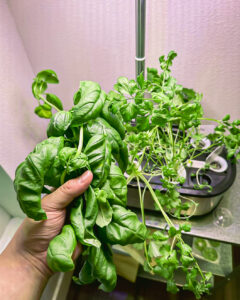
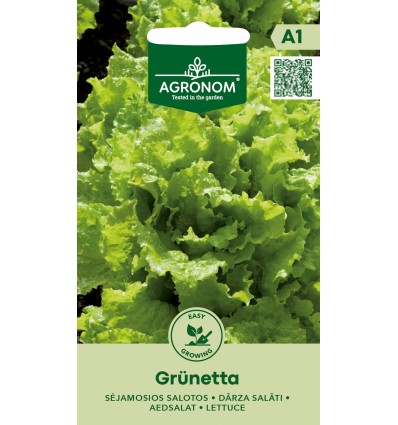
Cut and come again lettuce harvesting means taking only the mature outer leaves, cut 2 to 3 cm above the base, and never more than a third of the plant at once. The untouched central crown keeps producing new leaves, so one sowing delivers 3 to 5 harvests over 8 to 12 weeks.
The first time I cut a whole lettuce head out of my smart garden, I felt efficient for exactly one evening, and then stared at an empty pod for a month. The plant next to it, which I had only picked leaves from, fed me the entire time. That comparison turned me into a cut and come again convert, and a decade later it is still the highest-yield habit I know in indoor growing. Here is the method in full, including the two mistakes that stop lettuce from regrowing.
Why lettuce regrows at all
Cut and come again works because lettuce grows from the centre outward: the crown at the base pushes out new young leaves in the middle while the oldest, largest leaves sit on the outside. Harvest those outer leaves and the factory in the centre never stops. The University of Minnesota Extension confirms that picking individual leaves at baby size while leaving the small central leaves in place makes multiple harvests possible from one plant. Cut into the crown itself, even once, and regrowth stops, which is the single most common reason the method fails.
The method, leaf by leaf
A correct cut and come again harvest follows four steps that take about two minutes per plant. First, wait until the plant has at least 5 to 6 well-developed leaves, usually 25 to 35 days after sowing in a hydroponic system. Second, take the outer leaves only, cutting each one 2 to 3 cm above the base so the growing point stays untouched. Third, stop at a third of the plant, exactly as with herbs, because the remaining leaves power the regrowth. Fourth, leave the small centre leaves alone no matter how tempting they look, since they are the next harvest in two weeks’ time. I cover the same one-third logic across every kitchen plant in my guide to harvesting herbs without killing the plant.
Scissors beat fingers for lettuce
Lettuce leaves tear rather than snap, and a ragged tear at the base stays wet and invites rot in the humid air around a hydroponic deck. A clean snip with small scissors heals within a day, so a pair of indoor pruning scissors earns its place in the drawer next to the garden. Cut in the morning when leaves are at their crispest, and eat within a day or two, since loose leaves store less well than whole heads, which is fair payment for getting ten times the harvests.
What to expect, harvest by harvest
| Stage | When | What you get |
|---|---|---|
| First harvest | 25–35 days from sowing | 4–6 outer leaves per plant |
| Second and third | Every 7–14 days after | Full salad bowl from 2–3 plants |
| Fourth and fifth | Weeks 8–12 | Slower regrowth, smaller leaves |
| End of run | After 8–12 weeks | Plant bolts or fades, resow the pod |
Regrowth speed tracks temperature and light. In a smart garden running 12 to 14 hours of light a day, I am back at the same plant in 7 to 10 days, while a cooler windowsill stretches the cycle towards two weeks. Loose-leaf varieties are built for this method, and the ones I rotate through our own systems are listed in the lettuce seeds index, with my full type-by-type comparison in the guide to the best lettuce for smart gardens.
The whole-head variant, if you must
There is a second version of cut and come again where you cut the entire plant 2 to 3 cm above the base and let the stump regrow a complete new flush. It works, and I use it when a plant has grown uneven, but expect only one or two regrowths, each smaller and slightly more bitter than the original, because the plant loses every leaf that would have funded the recovery. Leaf-by-leaf picking keeps the engine running and yields more over the plant’s life, so I treat the whole-head cut as a reset button rather than a routine.
Staggering pods for a salad that never ends
One plant regrows in waves, so a continuous supply comes from offsetting those waves. I sow two lettuce pods two weeks apart, then resow each pod the day its plant starts bolting, which keeps a household of two in salad indefinitely from 286 cm² of counter. Starting from nothing, the LetPot Mini starter bundle plus one packet of loose-leaf lettuce is the whole shopping list, and the light side of the equation is covered in my guide to choosing a grow light for leafy greens.
Frequently asked questions
How many times will one lettuce plant regrow?
Picked leaf by leaf, 3 to 5 good harvests over 8 to 12 weeks is normal. Cut as a whole head, expect one or two smaller regrowths before the plant is spent.
How high above the base should I cut?
2 to 3 cm. Lower risks slicing into the crown, which ends regrowth permanently, and higher wastes the tender lower half of each leaf.
Why did my lettuce not grow back after cutting?
Either the crown was cut or too much was taken at once. A plant stripped past the one-third mark can stall for weeks, and a damaged crown never restarts. Leave the centre intact and the small leaves standing.
Does regrown lettuce taste different?
Later flushes trend slightly more bitter, especially in warm rooms, since bitterness builds as the plant ages towards bolting. Keeping the room under 24 °C and harvesting young keeps the flavour mild longest.
Does cut and come again work for butterhead and romaine?
Partially. Both regrow after a whole-head cut, but their value is the formed head, which leaf picking prevents. The method belongs to loose-leaf types, which are built to be picked.
Is this faster in a smart garden than on a windowsill?
Noticeably. Constant light and steady nutrients shorten the regrowth cycle to 7 to 10 days, against up to two weeks on a windowsill, which adds roughly one extra harvest to every plant’s life.
One sowing, a season of salads
Cut and come again is the rare technique where doing less, cutting fewer leaves and leaving the centre alone, produces more. Master the 2 to 3 cm cut and the one-third habit, and a single packet of seeds turns into months of salad. Every loose-leaf variety we stock for exactly this method is in the lettuce seeds collection, ready for the next sowing.