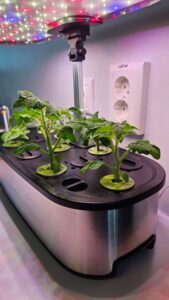
The number on a grow light’s box, whether it’s watts, lumens, or a “full spectrum” sticker, tells you far less than three things that are easy to check before you buy: the light’s actual spectrum, its wattage relative to the area it has to cover, and how far it sits from the leaves. The University of Missouri Extension’s guidance for indoor growers is direct about this, recommending that a grow light be judged by its photosynthetically active radiation (PAR) output and its placement rather than by the wattage or lumen rating printed on the box.
Wattage and lumens are measurements built for the human eye, not for a leaf, which is why a 20 W LED strip and a 20 W grow light panel can deliver very different amounts of usable light to a plant even though their boxes look similar. A “full spectrum” label says nothing about how much of that spectrum a plant can actually use, and a high lumen count can still leave seedlings stretching toward the window. This guide works through the variables that actually matter for plant growth: spectrum, wattage in relation to area, placement, and how long to run the light each day, so a fixture can be matched to what is actually being grown instead of guessed at from the packaging. For a broader introduction to grow lights in general, including when household lighting is enough and when it isn’t, this overview of how grow lights work is a good starting point.
Products mentioned — in stock at IndoorGarden, shipped from Tallinn across the EU.
What a grow light’s spec sheet is actually telling you
Most grow light packaging leads with wattage and lumens because those are numbers shoppers already recognise from household bulbs, but neither one describes what a plant receives at leaf level. The figure that matters is PPFD, photosynthetic photon flux density, which measures how many photons in the photosynthetically useful range land on a given area of leaf surface each second. The University of Missouri Extension recommends that growers look past wattage and lumen claims and check for PAR or PPFD data and a sensible mounting distance instead, since two fixtures with identical wattage can produce very different PPFD depending on their diodes, lenses, and how far they are mounted above the canopy.
In practice this means a listing that only advertises wattage and a vague “full spectrum” claim is giving a shopper the least useful information available. A spec sheet that includes spectrum coverage, a recommended mounting height, and ideally a PPFD figure at that height is a far better guide to what the light will actually do once it’s running above a shelf of herbs or a seed tray.
Spectrum: what the colour of the light actually does
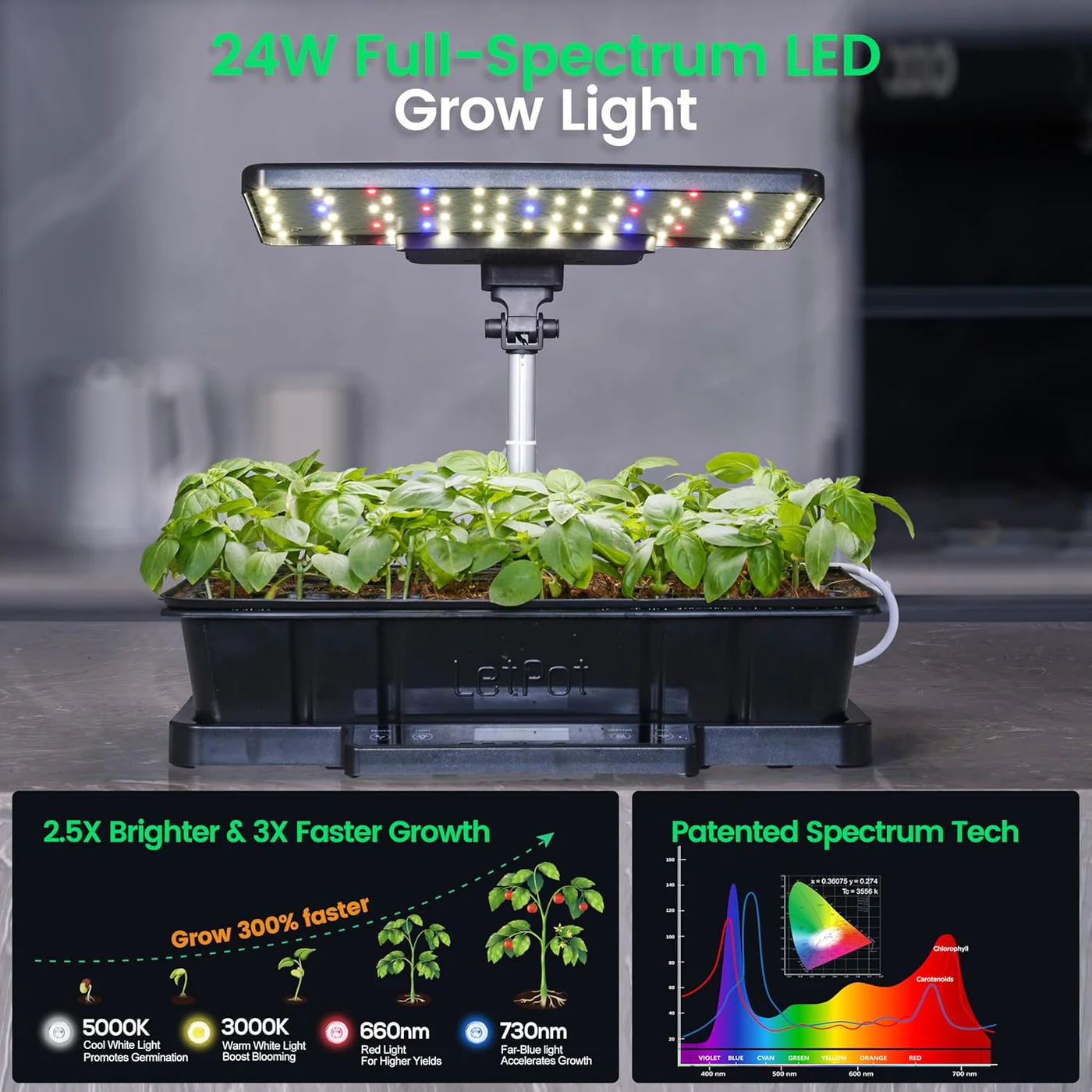
Plants use light across a fairly narrow band, roughly 400 to 700 nanometres, known as the photosynthetically active radiation range, and within that band blue and red wavelengths do most of the work. Blue light, around 400 to 500 nm, drives compact, sturdy growth and plays a role in photomorphogenesis and stomatal function, which is why seedlings grown under blue-rich light tend to stay short and thick-stemmed rather than leggy. Red light, around 600 to 700 nm, is the main energy source for photosynthesis itself and becomes more important as a plant matures and starts flowering or fruiting.
A “full spectrum” grow light is simply one designed to cover both ends of this range together, usually by combining several diode types rather than relying on a single wavelength. Kelvin colour temperature, the number sometimes printed next to a bulb’s wattage, is only a rough proxy for this balance: a lower Kelvin rating generally means more red in the mix, and a higher one means more blue, but it doesn’t replace an actual spectrum chart and shouldn’t be the only thing a buyer checks. Ultraviolet output is not necessary for ordinary indoor herbs and vegetables, so a light that skips UV entirely is not missing anything important for a typical home setup.
Wattage and coverage: what actually scales with plant area
Wattage becomes a genuinely useful number only once it’s considered against the area it needs to cover. Oklahoma State University Extension gives a rough sizing guide of around 25 W per square foot (roughly 270 W per square metre) for higher-light crops and closer to 16 W per square foot (about 170 W per square metre) for lower-light ones, as a starting point for supplemental indoor lighting. Translated to a small home tray of about 30 × 30 cm, which is around 0.09 m², that works out to roughly 15 to 20 W for herbs and leafy greens and roughly 25 to 30 W for a fruiting plant on the same footprint, though the exact figure still depends on the fixture’s efficiency and how close it’s mounted.
This is also why wattage alone cannot predict the PPFD a plant receives. A 100 W panel mounted close over a dense shelf of pots delivers far more light per plant than the same 100 W spread across a wide table, and a cheaper, less efficient diode can need more watts to match the output of a more efficient one. Wattage is a reasonable first filter when comparing similar fixtures from the same product line, but it stops being a reliable guide the moment different brands, diode types, or mounting heights are being compared.
Placement: why distance changes everything
Light intensity falls off with the square of the distance from its source, so moving a fixture twice as far from the canopy doesn’t halve the light reaching the leaves, it cuts it to roughly a quarter. Michigan State University’s floriculture program makes a related point for growers comparing fixtures: as a light’s total photon output (PPF) increases, the mounting distance generally needs to increase too, so a higher-output fixture mounted too far away isn’t automatically delivering more light to the plant than a lower-output one mounted closer.
As a starting range for home use, herbs and leafy greens generally do well with a grow light 20 to 30 cm above the canopy, seedlings and freshly germinated trays are usually kept closer, around 10 to 20 cm, and fruiting plants are typically raised gradually as they grow taller, moving from a closer starting distance up toward 25 to 40 cm as the canopy fills in. The plant itself gives useful feedback here too: stretched, pale, or leggy growth usually means the light is too far away or too weak for the distance it’s mounted at, while bleached patches or curling leaf edges near the fixture usually mean it’s mounted too close.
Photoperiod: how long to run the light each day
Spectrum, wattage, and distance only describe the light at a single moment. What a plant actually accumulates over a day is captured by Daily Light Integral (DLI), which is PPFD multiplied by the number of hours the light runs, and this guide to DLI covers target ranges for different crops in more detail. As a general starting point, herbs and leafy greens tend to do well on 12 to 16 hours of light a day, while seedlings and fruiting plants often do better nearer 14 to 16 hours.
Running a light for 24 hours doesn’t scale growth proportionally, and most common indoor crops actually need a period of darkness to carry out normal metabolic processes, so more hours isn’t automatically better once a crop’s DLI target has already been met. Matching photoperiod to DLI, rather than simply leaving a light on as long as possible, is usually the more reliable way to get consistent growth.
Matching a light to what you’re growing
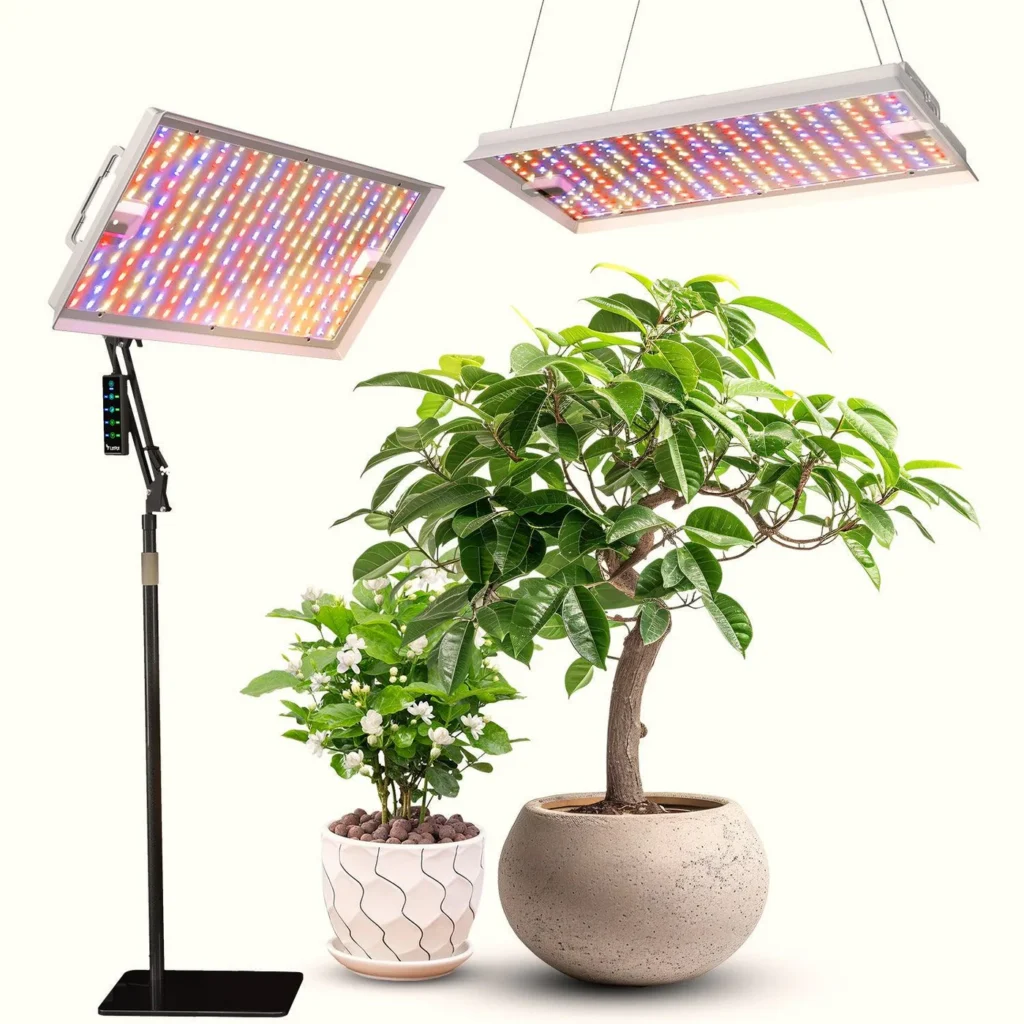
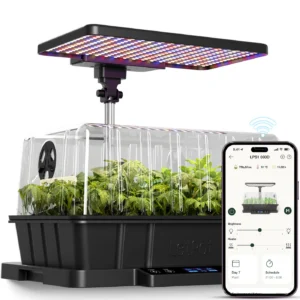
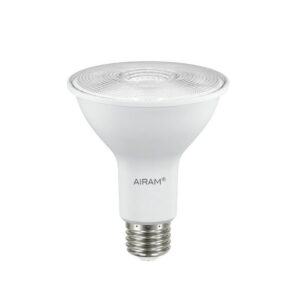
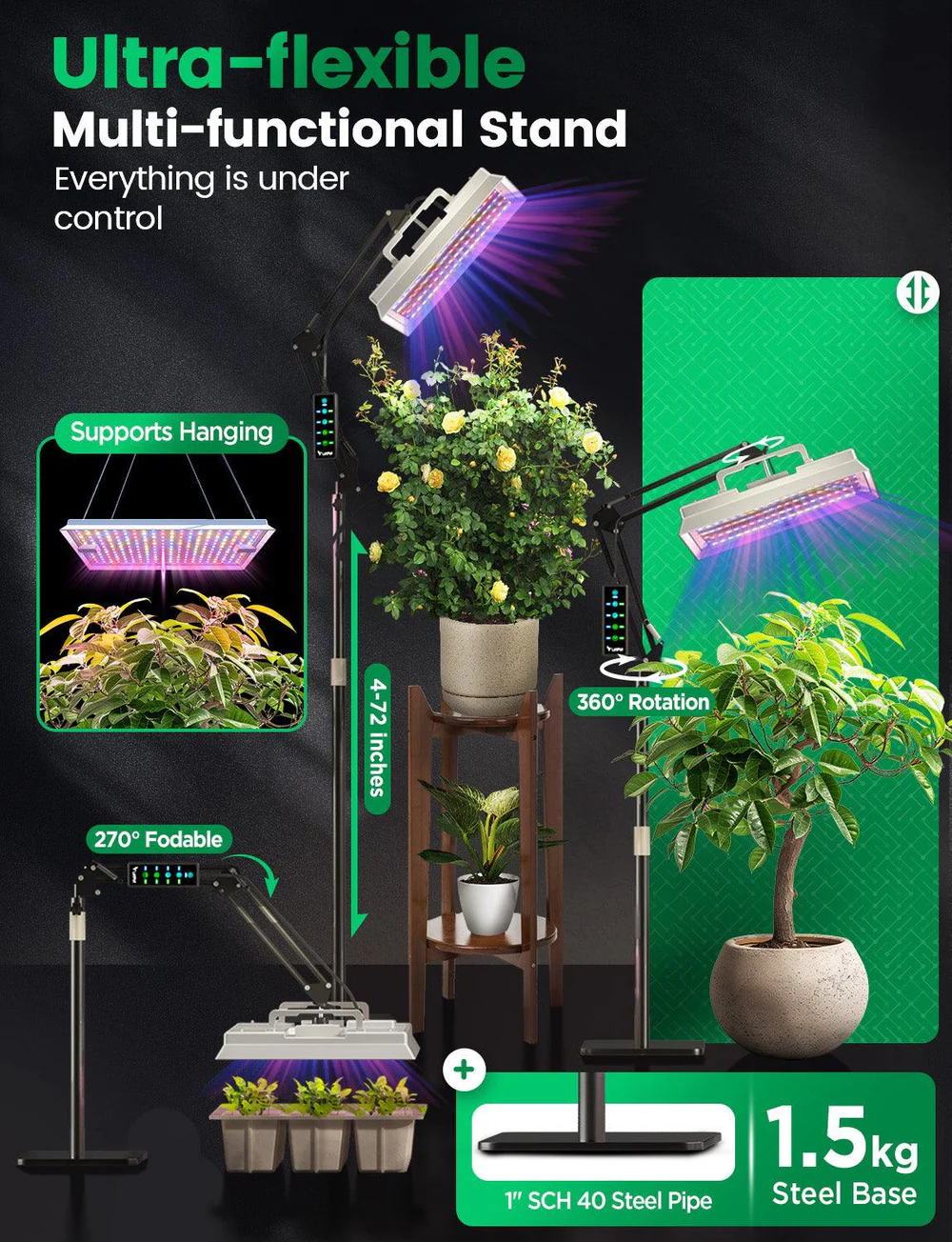
Once spectrum, wattage, distance, and photoperiod are accounted for, the remaining question is simply which fixture suits the plants on hand. A single pot or small seedling tray on a windowsill or shelf generally only needs a compact spot-style light such as the Airam PAR30, run on a timer for the hours described above. A seed-starting stage benefits from a fixture built specifically for germination, such as the LetPot SS-Pro seed starter kit, which pairs a 24 W full-spectrum light with a heated base and app control to keep both temperature and light consistent while seeds establish. A full herb shelf, a smart garden, or a taller fruiting plant is usually better served by a wider panel such as the LetPot 100 W full-spectrum grow light, which can stand or hang and covers a larger area at the distances described above.
| Light | Power | Best suited for | Typical mounting distance | Price |
|---|---|---|---|---|
| Airam PAR30 | 9.5 W | Single pot or houseplant | 20–30 cm | €13.99 |
| LetPot SS-Pro seed starter kit | 24 W + heated base | Germinating seed trays | 15–25 cm (fixed stand) | €119.99 |
| LetPot 100 W grow light | 100 W | Herb shelf, smart garden, or fruiting plant | 25–40 cm, raised as the plant grows | €159.00 |
Frequently asked questions about grow lights
Do I need a “full spectrum” light, or will any white LED work?
A plain white household LED can supply some usable light, but it isn’t built to balance blue and red wavelengths the way a full-spectrum grow light is, so growth under a household bulb is usually slower and less even. For anything beyond a very low-light houseplant, a dedicated full-spectrum fixture is the more reliable choice.
How close should a grow light be to seedlings?
Most seedlings and freshly germinated trays do well with a light positioned around 10 to 20 cm above the tray, moved closer or further depending on how the seedlings respond, since stretching usually signals the light needs to come closer.
Does a higher wattage always mean a stronger light at the plant?
No. Wattage only predicts light intensity at the plant when the diode efficiency and mounting distance are also accounted for, which is why two fixtures with the same wattage can produce noticeably different results.
Can one grow light cover both herbs and a taller fruiting plant?
A single wide panel such as the LetPot 100 W fixture can cover both if it’s mounted high enough to clear the taller plant and then adjusted or supplemented for the shorter herbs nearby, though two separate lights at two different heights is usually simpler to manage.
How many hours a day should a grow light run?
Most herbs and leafy greens do well on 12 to 16 hours a day, while seedlings and fruiting plants often do better nearer 14 to 16 hours, with the exact figure depending on the crop’s target DLI rather than a fixed rule.
Is a more expensive grow light always the better choice?
Not necessarily. The right choice depends on matching the fixture’s spectrum, wattage, and coverage to the specific plants and space involved, and a smaller, cheaper light can easily outperform a larger one that’s mismatched to the job.
Where to start
For a single pot or a small seedling tray, the Airam PAR30 is the simplest starting point. For a herb shelf, a smart garden, or a taller fruiting plant, the LetPot 100 W grow light covers more ground at the distances described above. The full range of fixtures, including both of these, is available in the grow lights category, and the free DLI calculator and other indoor gardening tools can help translate any of this into a schedule for a specific plant and space.