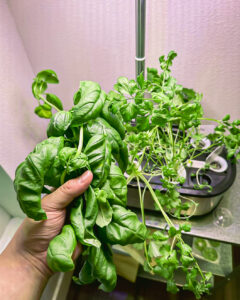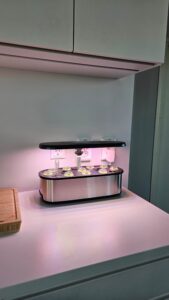
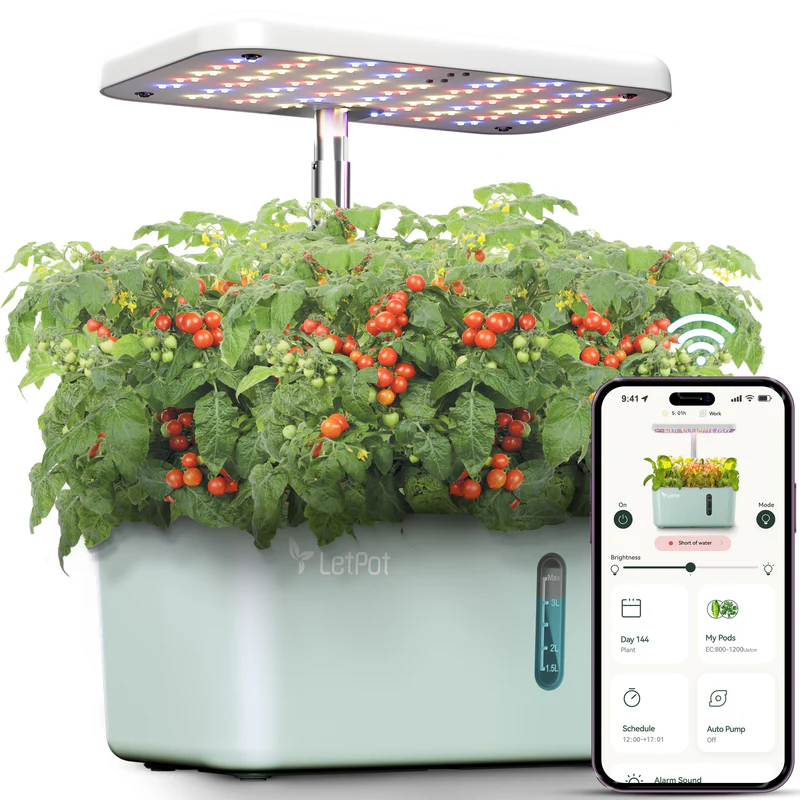
LetPot vs Click & Grow comes down to one decision: an open system you fill with your own seeds, or sealed pre-seeded pods you reorder for life. LetPot gives you more planting holes, active water circulation and real app automation at a lower cost per harvest. Click & Grow answers with silent passive watering, a compact shape and the simplest start in the category.
Both systems run on the same basic idea: a water tank, a full-spectrum LED and an automatic timer that let plants grow without soil or a sunny window. Where they differ is how water reaches the roots and how far you can scale up before needing a bigger unit. This comparison is written for a European kitchen and a European power bill, weighing pods, running cost, capacity, automation and energy use point by point.
Key specifications side by side
| Model | Pods | Light power | Water tank | Max plant height | Width | Price at IndoorGarden, VAT included |
|---|---|---|---|---|---|---|
| Click & Grow Smart Garden 3 | 3 | 8 W | see manufacturer | not published | 30 cm | see clickandgrow.com |
| LetPot Mini | 5 | 10 W | 1.5 L | 29 cm | 22 cm | 59 € |
| LetPot Air | 10 | 24 W | 4 L | 36 cm | 39 cm | 89 € |
| LetPot Lite | 12 | 24 W | 5.5 L | 41 cm | 41 cm | 109.99 € |
| LetPot Senior | 12 | 24 W | 5.5 L | 76 cm | 41 cm | 129 € |
| LetPot Max | 21 + 2 large | 36 W | 7.5 L | 76 cm | 41 cm | 249 € |
Prices and stock checked on 12 September 2026. Click & Grow figures come from the manufacturer’s published Smart Garden 3 specifications; LetPot figures come from the manufacturer’s specifications for the units we sell from Tallinn.
How the two systems actually work
A smart garden is a countertop growing unit that pairs a water tank, a full-spectrum LED and an automatic timer so plants grow without soil or a bright window. Both brands fit that description, and then they part ways on the detail that matters most, which is how water reaches the roots. Click & Grow uses what it calls smart soil, a peat-based pod that wicks moisture up to the seed on its own, so the unit markets itself as easier than hydroponics rather than true hydroponics. LetPot runs a small pump that circulates an oxygenated nutrient solution around bare roots, which sits much closer to the deep-water hydroponics commercial growers rely on. The practical result is that a Click & Grow tank can stand untouched for up to three weeks, while a LetPot moves water actively and feeds faster, hungrier growth.
Pods, seeds and the running cost
This is where most of the money lives. Click & Grow sells sealed pre-seeded pods in more than 70 varieties, and every replanting means buying a fresh set, which keeps the system tidy and removes all guesswork but ties you to one supplier for years. LetPot ships empty grow sponges and lets you sow whatever seed you like, from a 30-cent supermarket herb packet to a saved tomato seed, so the running cost after the first purchase can fall close to zero. As a rough example, a household that replants four times a year buys four pod sets for a Click & Grow but little more than a seed packet or two for a LetPot, and that difference often covers a large share of the unit’s price within the first year. This is the single biggest reason an open system tends to work out cheaper for cost-conscious growers. If you want to see how that looks in practice, the LetPot Mini 5-pod smart garden is the model most first-time buyers start with, and the trade-off is covered in more depth in the guide to the best Click & Grow alternatives.
Capacity and the plants you can grow
Capacity is the second dividing line. Click & Grow keeps things small with 3-pod and 9-pod units that suit herbs, salad leaves and a few compact fruiting plants. LetPot spans a much wider range, from the 5-pod Mini up to the LPH-Max with 21 small pods plus 2 large pods, and its taller light arms clear headroom for dwarf tomatoes, chillies and bushy basil that would soon crowd a Click & Grow lid. According to Gardening Know How’s LetPot review, that 21-pod Max can effectively hold a whole salad garden on one counter, though the tester noted the automatic mode needs a separate 7-litre reservoir. If you are weighing one LetPot size against another, our LetPot model comparison lays the range out side by side.
LetPot vs Click & Grow at a glance
| Feature | Click & Grow | LetPot |
|---|---|---|
| Growing method | Passive wicking smart-soil pods | Active pump hydroponics |
| Pod count | 3 or 9 pods | 5 up to 21 + 2 pods |
| Seeds | Proprietary pre-seeded pods, 70+ types | Any seed in a refillable sponge |
| Watering | Refill tank roughly every 3 weeks | Pump circulates, app-managed |
| Power use, smallest model | 8 W, 3.8 kWh per month | Around 24 W on the 10-pod Air |
| App control | Reminders only | WiFi light and watering control |
| Best for | Maximum simplicity, small spaces | Lower running cost, bigger harvests |
Energy, noise and footprint on a European counter
Both systems are cheap to run, but they differ in sound and size. A Click & Grow Smart Garden 3 draws just 8 watts and around 3.8 kWh per month according to Click & Grow’s published specifications, which is roughly 45 kWh across a full year, or the price of a few coffees even at high European electricity rates. It measures 300 mm wide, 120 mm deep and 210 to 470 mm tall, weighs 1.2 kg, and its passive watering makes no sound at all, which matters in a studio where the garden shares space with your bed. LetPot units pull a little more power because the lights are larger, with the 10-pod Air rated around 24 watts, and the circulation pump adds a soft intermittent hum that most people stop noticing within a day. Their squarer tanks and adjustable metal light arms look like growing equipment rather than décor, which is the right trade when the goal is harvest volume. Neither design will move your monthly bill in any meaningful way.
Maintenance across a full growing year
Over twelve months the two systems ask for different habits. Click & Grow wants a tank top-up roughly every three weeks, a fresh set of pods when a crop is spent, and an occasional wipe of the water sensor, and that is genuinely the whole list. LetPot asks for a little more, with a full nutrient change every two to three weeks, a quick rinse of the pump and pipes between crops, and the ongoing job of sowing and thinning your own seedlings. The LetPot routine is more involving, since sowing and thinning keep you checking on the plants, while a busy household may still prefer the set-and-forget rhythm of the passive system. Neither needs more than ten minutes of hands-on care in any given week.
Which one should you buy
Choose Click & Grow if you want the shortest path from box to first sprout, you are happy to reorder pods, and a tidy white unit with three or nine herbs is exactly enough. Choose LetPot if you want to grow from your own seed, fill more pods for less, or step up to fruiting plants and bigger harvests, and if controlling the light and pump from your phone appeals to you. For most European home growers who plan to keep going past the first novelty months, the open system pays for itself and grows with you, which is why most of the smart gardens we recommend come from the more flexible side of this comparison.
Frequently asked questions
Can I use my own seeds in a Click & Grow?
You can buy empty Click & Grow pods and add your own seed, but they are not sold everywhere and the refill economics still favour an open system like LetPot, which is built around bring-your-own seed from the start.
Is LetPot harder to use than Click & Grow?
Slightly, because you sow seed yourself and manage a pump-based tank, but the gap is small. Most people feel comfortable after a single planting cycle, and the app walks you through the light and watering schedules.
Which is cheaper over a year?
LetPot almost always wins on running cost because you are not rebuying proprietary pods. Upfront prices overlap between the ranges, so the long-term saving comes from seeds rather than from the hardware.
Do either work without natural light?
Yes. Both include full-spectrum LEDs designed to grow plants in a windowless corner, so a north-facing flat or a basement kitchen is no obstacle for either brand.
Can I grow tomatoes or chillies?
LetPot is the better choice for fruiting plants because its taller light arms and larger pods give roots and stems room to work. Click & Grow can manage dwarf varieties but runs out of headroom faster.
Are these available across Europe?
Yes. Both ship widely in the EU, and at IndoorGarden we stock and support the LetPot range from Estonia, so spare sponges and parts reach the whole continent without a customs headache.
Which one to choose
Click & Grow works well as a gift and an easy first week, while LetPot tends to make the better long-term garden once the routine is familiar. If you already know you want to grow more than a few herbs, starting with the flexible system usually means skipping an upgrade later. Browse the full range of smart gardens we stock, then pick the size that fits your counter and your appetite.