The best smart garden in 2026 for most European home growers is an open, app-connected system like LetPot, which lets you grow from your own seed at a low running cost. Click & Grow wins for pure simplicity, while Gardyn and Rise suit big harvests if you can find them in Europe and pay the premium. Match the system to your space, budget and how hands-on you want to be.
Every January my inbox fills with the same question: which smart garden should I actually buy this year? I have grown in most of the big systems, watched brands appear and vanish, and learned that a glowing American review means little if the unit never ships to Tallinn or Berlin. So this is a 2026 roundup written from a European counter, judged on what you can buy here, run cheaply, and keep alive long past the first excited month.
What changed for smart gardens in 2026
The category looks different than it did a couple of years ago. The big shift is that open systems, which let you bring your own seed, have gone from niche to mainstream, with LetPot in particular filling out a full range from tiny to large and pushing app control down to budget prices. Closed-pod gardens still sell on convenience, but buyers have caught on to the long-term cost of branded refills. The American giant AeroGarden went through an ownership change and a relaunch, which left its European supply uneven for a while, and that gap pulled more local attention toward brands that actually warehouse stock in the EU. LED prices kept falling, so even cheap units now ship with usable full-spectrum lights. The practical takeaway for 2026 is that you no longer pay a premium for flexibility, and the smart move is to choose a system on running cost and availability rather than on novelty.
What makes a smart garden worth buying
A smart garden is a self-contained countertop system that combines a water reservoir, a full-spectrum LED and an automatic timer so plants grow without soil or a sunny window. Once you strip away the marketing, only a few things separate a good one from a gimmick. The first is the seed system, because a closed system ties you to branded pods for years while an open one takes any seed you like. The second is capacity, measured in planting holes and in the headroom above them. The third is running cost, which is mostly light energy plus whatever you spend refilling pods or seeds. The fourth, and the one most lists ignore, is whether the thing is actually sold and supported in Europe. A 36-pod tower is no use if it needs a North-America-only lighting accessory and three weeks of customs.
The six smart gardens at a glance
Here is how the main contenders stack up for a European buyer, with the details that actually change your decision.
| System | Pods | Seed system | Best for | Europe |
|---|---|---|---|---|
| LetPot (Mini to Max) | 5 to 21 + 2 | Open, any seed | All-round value | Stocked locally |
| Click & Grow 3 / 9 | 3 or 9 | Closed pods | Total beginners | Widely available |
| AeroGarden Harvest | 6 | Closed pods | Familiar classic | Patchy, third-party |
| iDoo 12-pod | 12 | Open, any seed | Tight budgets | Via marketplaces |
| Gardyn Home | 30 | Closed cups | Big harvests | Limited, premium |
| Rise Garden | 8 to 36 | Open seed | Multi-tier growing | Limited, premium |
LetPot: the best all-round choice in Europe
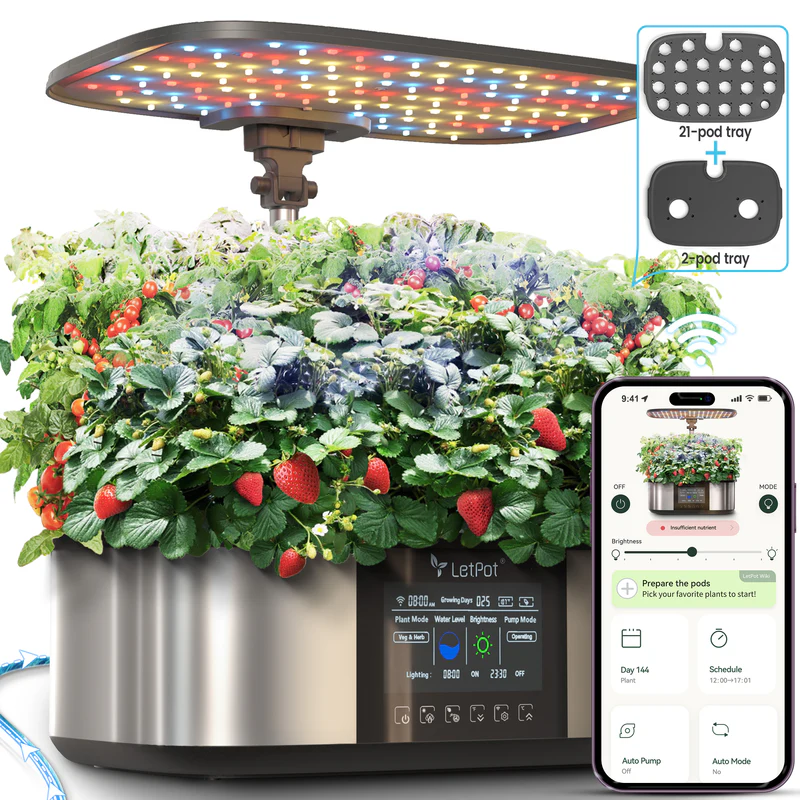
LetPot is the system I reach for first, and the one I stock, because it answers the four criteria above better than anything else at the price. The range runs from the 5-pod Mini up to the LPH-Max with 21 small pods plus 2 large pods, so a single family of products covers a windowsill herb habit or a serious salad operation. Every model takes your own seed in a refillable sponge, the lights are bright full-spectrum panels rather than a token glow, and the app controls both the light schedule and the circulation pump from your phone. The pump adds a soft hum and a little more power draw than a passive pod garden, but in exchange you get faster growth, bigger plants and genuine automation, including a holiday mode that keeps the tank topped up while you travel. In Gardening Know How’s hands-on review the 21-pod Max grew a kitchen full of salad and herbs through winter, which matches my own experience. If you want the short version of which size suits you, my LetPot model comparison lines them up, and the LetPot Mini 5-pod smart garden is where most first-timers should start.
Click & Grow and AeroGarden: the set-and-forget classics
If you want the least possible effort, the closed-pod systems still have a place. Click & Grow, designed in Estonia, sells 3-pod and 9-pod units that draw just 8 watts on the smallest model and need almost no thought, since the pre-seeded pods remove every decision and the passive watering runs silent for up to three weeks. The trade is cost and freedom, because you reorder pods for the life of the unit. AeroGarden is the long-running American name, with 6-pod Harvest units that grow fast and cost under a euro a month to run, though after a turbulent few years its European availability is patchy and usually comes through third-party sellers rather than a local warehouse. Both are genuinely easy. Neither lets you sow a saved tomato seed or a supermarket basil packet, which is the freedom that keeps me on the open side.
Gardyn, Rise and Lettuce Grow: big harvests, big footprints
At the top end sit the vertical systems built for volume. Gardyn packs 30 plant slots and a roughly 23-litre reservoir into a tall tower with cameras and a polished app, and Rise Garden offers stackable tiers that scale from 8 plants to 36 across multiple levels. Lettuce Grow’s Farmstand reaches just over 1.8 metres with 36 openings. A Gardyn or a Rise can put a continuous supply of lettuce, kale and herbs on the table for a family of four, and the multi-tier designs use vertical space cleverly so the floor footprint stays smaller than the plant count suggests. These grow a remarkable amount of food, but they share three problems for a European buyer: they are expensive, they are physically large, and their distribution is heavily North American, so spares and accessories can be slow or impossible to source here. Lettuce Grow even needs separate Glow Rings to work indoors at all. If you have the space, the budget and a reliable import route, they are impressive. For most flats, they are more garden than the kitchen can hold.
Running costs you should expect
Electricity is the smallest worry. A Click & Grow Smart Garden 3 uses about 3.8 kWh a month, which is a couple of euros even at high European tariffs, and an AeroGarden Harvest runs for under a euro a month by the maker’s own figures. Larger panels on a LetPot Air sit around 24 watts and still barely register on a bill. The cost that actually adds up is consumables. On a closed-pod system you rebuy a set of pods every planting cycle, perhaps four or more times a year, while on an open system you spend a few cents on seed and the occasional sponge. Over a single year that difference often equals a large slice of the hardware price, which is why I keep steering people toward open systems once they are past the first crop.
How to choose for your space, budget and habits
Start with your counter, because the footprint decides more than any feature list. For a windowsill or a studio, a 3-pod to 6-pod unit such as a small LetPot or a Click & Grow is plenty, and you can read my picks for compact kitchens in the guide to top-rated self-watering herb garden sets. For a family that cooks daily, jump to a 12-pod to 21-pod system so you are harvesting something most weeks. Then weigh how hands-on you want to be, since a closed-pod garden is the path of least resistance while an open system rewards a little involvement with far lower running costs and any plant you fancy. Finally, check the European availability before you fall in love with a tower you cannot actually buy.
Frequently asked questions
What is the best smart garden for beginners in 2026?
For absolute beginners who want zero decisions, a Click & Grow 3 is the simplest start. For beginners who want room to grow and lower long-term costs, a small LetPot is the better first buy because it scales and takes any seed.
Are smart gardens expensive to run?
No. The smallest units draw around 8 watts and cost roughly a euro or two of electricity a month, and even the larger panels stay modest. The real ongoing cost is pods on closed systems, which an open system avoids.
Can I grow more than herbs?
Yes. Leafy greens, lettuce and compact fruiting plants like dwarf tomatoes and chillies all work, especially in taller systems with adjustable lights. The more headroom and pods a unit has, the wider the range you can grow.
Open or closed pods: which is better?
Closed pods are simpler and tidier but lock you into branded refills, while open systems take any seed and cost far less to run. For most people who plan to keep growing, open wins on both cost and choice.
Which smart gardens are easy to buy in Europe?
LetPot and Click & Grow are the most reliably available across the EU. AeroGarden appears through third-party sellers, while Gardyn, Rise and Lettuce Grow are largely North American and harder to source with local support.
Do I need a sunny window?
No. Every system here includes full-spectrum LEDs that replace daylight, running around 16 to 18 hours a day, so a windowless kitchen or a north-facing flat grows just as well.
My pick for 2026
If you want one honest recommendation, buy an open, app-connected system sized to your counter and grow from your own seed. It costs less over a year, it grows whatever you want, and in Europe it is the easiest to actually buy and keep running. You can browse the full range of smart gardens I trust and grow with, then match the size to your kitchen and how much you like to cook.