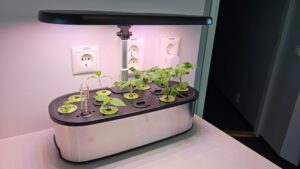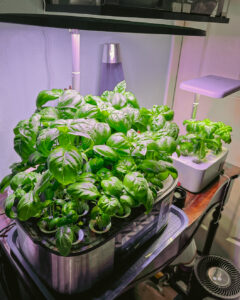
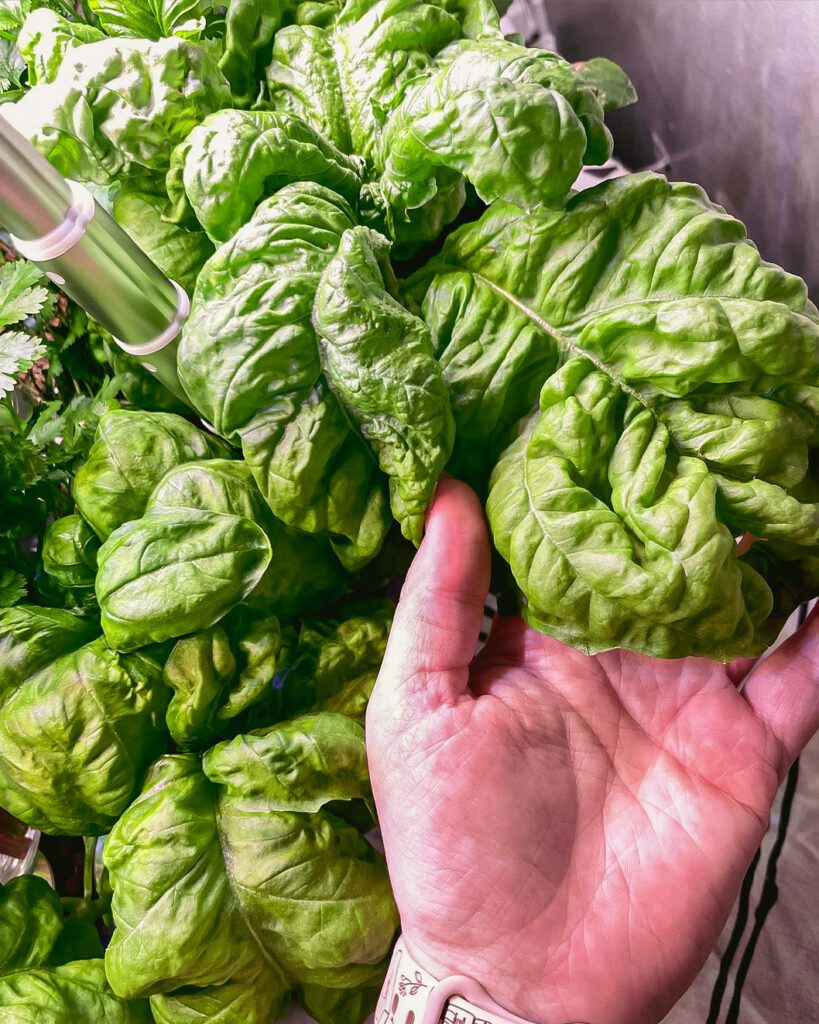
Hydroponics is a way of growing plants without soil, where the roots get their nutrients straight from a water solution. Over the first 30 days at home, the usual path runs from seed to first harvest: seeds typically germinate within 5–10 days, growth is fastest in weeks 2–3, and the first herbs or leafy greens are usually ready to pick around day 25–30.
Home hydroponics has become one of the most popular ways to grow fresh greens on a kitchen counter or windowsill. There’s no soil, no mess, and plants often grow faster than in a regular pot — mainly because the roots always have direct access to water and nutrients instead of having to search for them in soil. This guide walks through what happens week by week during that first growing month, so you know what to expect.
Products mentioned — in stock at IndoorGarden, shipped from Tallinn across the EU.
What hydroponics is and how it works without soil
In a hydroponic system, a plant’s roots reach down into a water solution that already contains every nutrient it needs — nitrogen, phosphorus, potassium and trace elements. Instead of soil, the seed or seedling is usually held by a grow sponge or similar medium that simply keeps it in place until the roots reach the water. Because nutrients are immediately available to the roots, the plant doesn’t spend energy searching for them the way it would in soil — one of the reasons hydroponic plants are often cited as growing faster than their soil-grown counterparts.
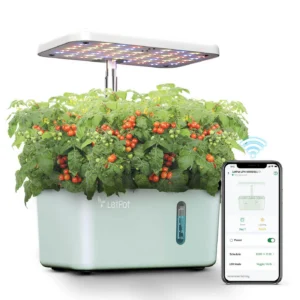
Home systems such as the LetPot Mini automatically maintain the water level and, depending on the model, the lighting schedule, so a beginner doesn’t need to manage complicated technical upkeep — checking the reservoir now and then is usually enough.
Days 1–7: setting up the system and the first seedlings
The first week is about setting up the system and germinating seeds. University of Minnesota Extension recommends 12–16 hours of light per day for seedlings, which also applies to hydroponic systems using grow lights. Most herb seeds, such as basil, germinate within 5–7 days when the water temperature is kept around 20–24°C.
The priority at this stage is not to rush: until a seedling has a real root system, it doesn’t need extra nutrients — clean water is enough. Adding too much nutrient solution too early is one of the most commonly mentioned beginner mistakes, because young roots aren’t ready to take it up yet.
Days 8–14: roots, water and nutrients
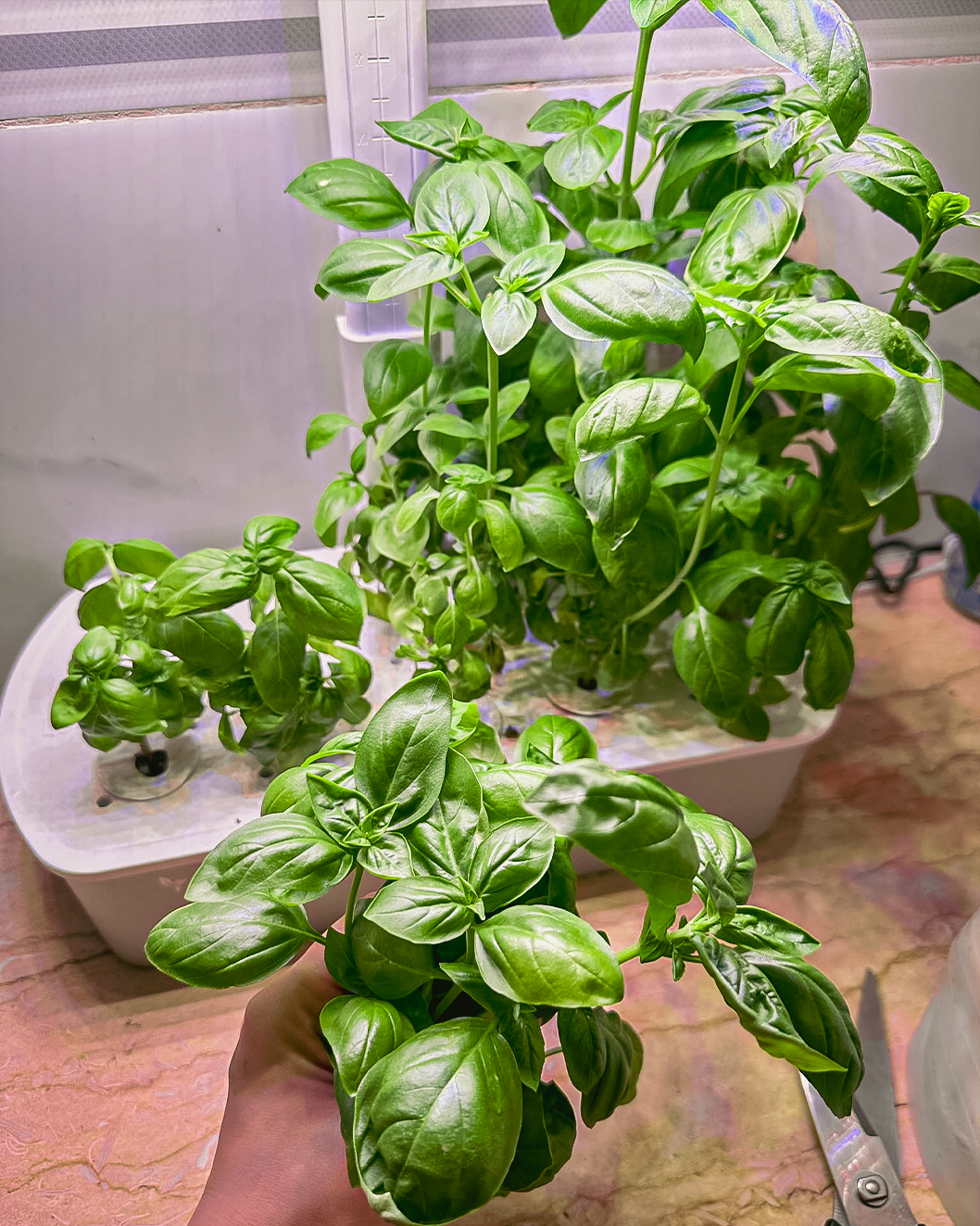
By the second week, seedlings usually have their first real roots, and that’s when nutrient solution can start being added. Oklahoma State University Extension notes that leafy herbs and lettuces typically do well at an electrical conductivity (EC) of about 1.2–1.6 mS/cm, while fruiting plants such as tomatoes need more, around 2.0–4.0 mS/cm. The same guidance recommends keeping water pH between 5.5 and 6.5 and water temperature around 20–24°C so roots can take up nutrients efficiently.
If you don’t have an EC or pH meter, starting with the manufacturer’s recommended dose and watching the plant works too: pale or yellowing leaves often point to a nutrient shortage, while dark green but slow-growing plants can suggest too much.
Days 15–21: light and growth pace
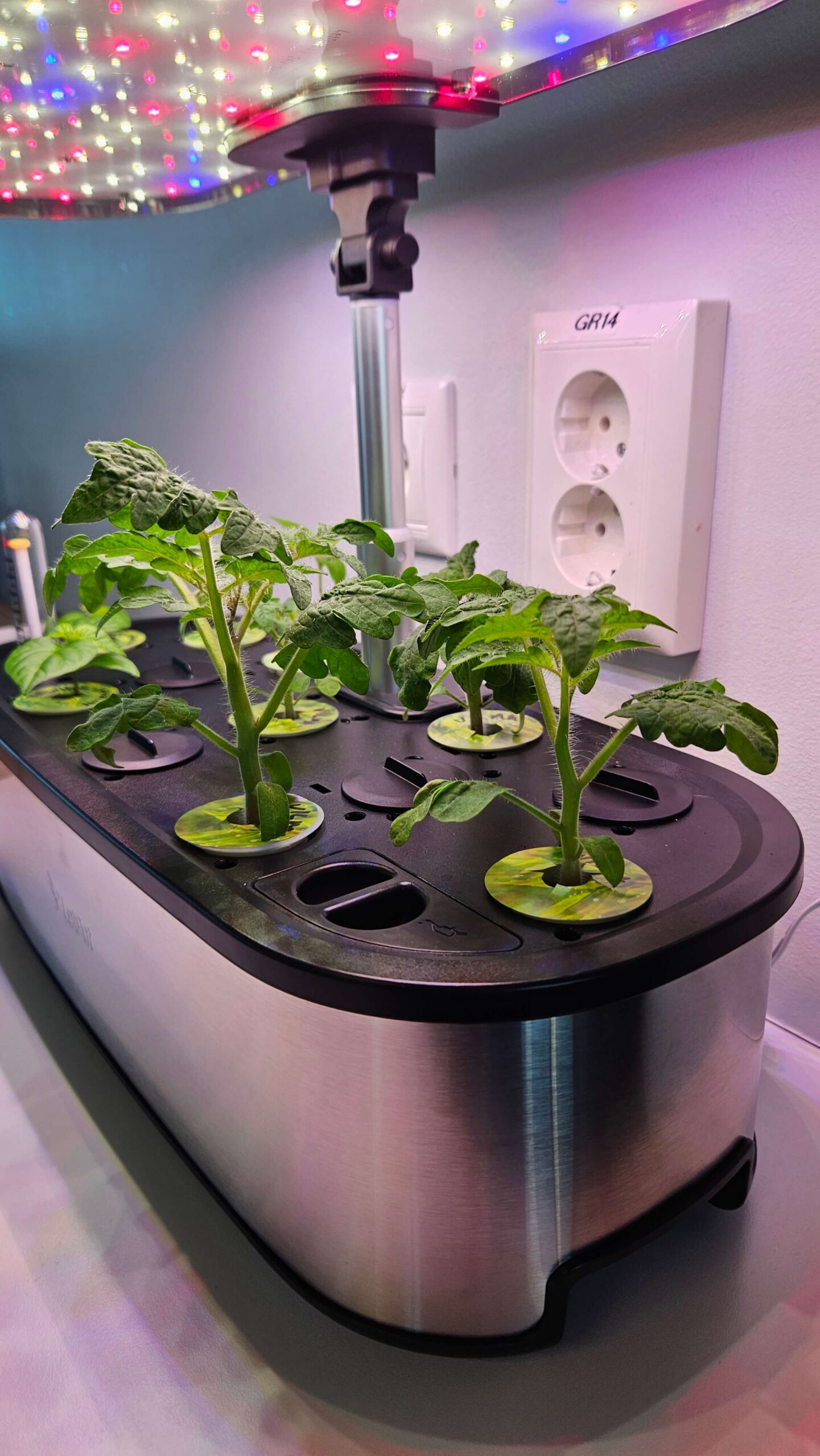
The third week is usually the fastest-growing period — the plant already has a developed root system and a steady nutrient supply, so leaf count and size pick up noticeably compared with the first two weeks. Light becomes the main limiting factor here: if a plant is stretching upward with small, pale leaves, that usually means it isn’t getting enough light, or the light is too far away.
If you’re using a supplemental grow light, check that its distance from the plant matches the manufacturer’s recommendation — an easy fix at this stage that can make a real difference to the final harvest.
Days 22–30: the first harvest and an ongoing routine
For many greens and herbs, the fourth week brings the first harvest. Utah State University Extension recommends the so-called “one-third rule” — picking no more than a third of a plant’s leaves at a time, so enough leaf area is left for photosynthesis and continued growth. That lets you harvest a herb repeatedly rather than taking everything at once.
This is also when an ongoing care routine starts to take shape: topping up water periodically, changing the nutrient solution on the schedule the manufacturer recommends, and harvesting regularly, which encourages the plant to branch out and produce more leaves.
Common beginner mistakes in the first month
A handful of mistakes come up again and again for people trying home hydroponics for the first time:
Changing the water too often. A full water change every day isn’t necessary and can disrupt a stable nutrient concentration — usually it’s enough to follow the manufacturer’s schedule and simply top up water lost to evaporation.
Leaving the reservoir in direct sunlight. If a water reservoir sits in direct sun for long periods, the water warms up and algae can start growing faster — a spot with indirect light, or a covered reservoir, works better.
Increasing nutrient strength too early. Wanting to “speed up” growth by adding more nutrient solution than the manufacturer recommends usually backfires — roots can burn, slowing the plant down instead of speeding it up.
Prices and what you need to get started
| Product | Price | Best for |
|---|---|---|
| LetPot Mini (5-pod smart hydroponic garden) | €59.00 | Beginners, compact, automatic water top-up |
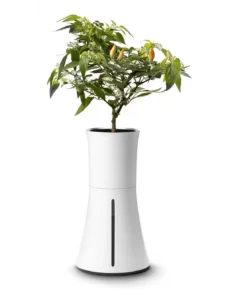
| Botanium hydroponic pot | €69.00 | Scandinavian design, automatic watering, one plant |
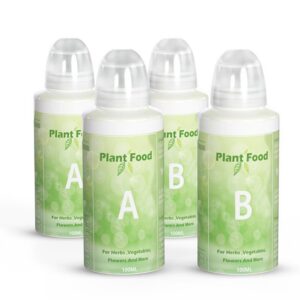
| LetPot hydroponic nutrient solution | €17.99 | Top-up nutrients for an existing system |
Frequently asked questions
How long does seed germination take in a hydroponic system?
Most herb seeds germinate within 5–7 days at a water temperature around 20–24°C. Some, such as parsley, can take longer.
Do I really need an EC and pH meter?
Not at the start — you can follow the manufacturer’s recommended dose and watch how the plant looks. Meters become useful once you want to understand more precisely why a plant looks off.
Why are my seedlings tall and thin (leggy)?
That usually points to a lack of light — the seedling is stretching to find it. Check the light’s daily duration and its distance from the plants.
How often does the reservoir need topping up?
It depends on the system size and how many plants you’re growing, but most small home systems need a water top-up every one to two weeks.
How much space does a hydroponic system need at home?
Compact systems like the LetPot Mini take up about as much space as a large pot, and fit easily on a kitchen counter or windowsill.
What happens if I miss one nutrient top-up?
One missed top-up usually won’t cause harm — the plant will just slow down temporarily. Missing top-ups regularly will weaken the plant over time.
Where to start
If you want to start hydroponics at home, the compact LetPot Mini is one of the easiest places to begin — it keeps the water level topped up automatically, which makes the first month much easier. You’ll find nutrient solutions and other accessories in the smart garden accessories category, and a wider range of systems under smart gardens.