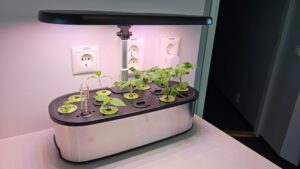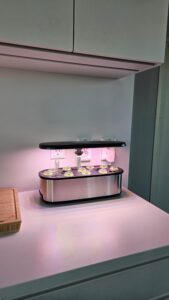

A 21-pod countertop hydroponic system such as the LetPot Max runs an estimated €4 a week in hardware, electricity and nutrients combined, which is close to what a kitchen spends on two or three fast-wilting herb bunches from a supplier — narrowing the price gap, though not closing it for high-volume use.
Basil wilts within days, coriander bolts in a warm pass-through, and parsley bruises on a busy prep line. For a kitchen that goes through herbs daily, that short shelf life means either over-ordering and binning the surplus, or running out mid-service. A countertop hydroponic unit grows a steady supply of cut-and-come-again herbs on the counter, with no soil, no delivery schedule and no cold-chain handling between grower and kitchen. This article covers what it costs to run one, what grows well in it, the hygiene basics, and where a supplier still makes more sense.
Products mentioned — in stock at IndoorGarden, shipped from Tallinn across the EU.
What a countertop hydroponic system actually does for a kitchen
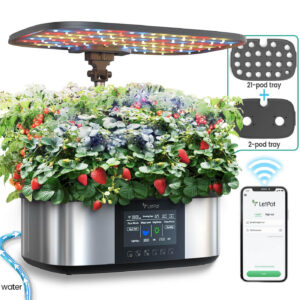
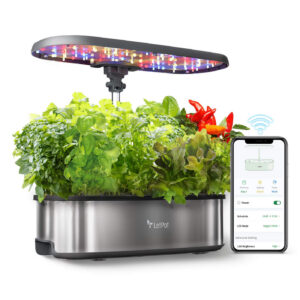
A hydroponic smart garden such as the LetPot Max grows herbs in a nutrient solution instead of soil, with a built-in LED panel and a small pump that circulates water on a schedule. There is no potting mix to spill near a prep station and no tray of soil to attract pests — the whole system sits in a sealed reservoir with seed pods on top. For a kitchen, the main draw is supply reliability rather than novelty: once a pod germinates, it keeps producing leaves for weeks, so a cook can cut what is needed for service without waiting on a delivery.
CBI’s market research notes that grow-your-own and potted herb demand has been rising specifically in Northern Europe, and that European wholesale supply leans more heavily on imports between autumn and spring, when local outdoor production drops off. A unit growing under LED light indoors does not notice the season, so winter — when supplier herbs are more likely to have travelled further and cost more — is usually when the freshness and cost gap narrows the most.
Weekly running cost: hardware, electricity and nutrients versus a supplier bunch
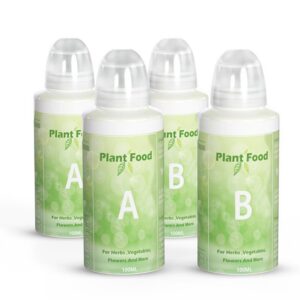
Spread over 24 months, the LetPot Max (€249.00) works out to roughly €2.40 a week in hardware alone. Its 36 W LED panel adds about €4.30 a month in electricity at typical Baltic household rates — see our smart garden electricity cost breakdown for country-by-country figures — which comes to roughly €1 a week. A bottle of nutrient solution (€17.99) typically covers several refill cycles for one unit, adding a further €0.50–0.70 a week with regular dosing. All in, a 21-pod system running continuously lands at roughly €4 a week before counting seeds.
Supplier herb bunches commonly run €1.50–3 in Baltic wholesale, so two to three bunches a week of a fast-wilting herb like basil or coriander already sits close to that figure. The hydroponic unit does not undercut a supplier on a single ingredient bought in bulk, but it removes the over-ordering and binning that comes with matching a delivery minimum to what is actually used each day — and a bunch that wilts unused before the next delivery is a cost a weekly supplier invoice does not show on its own.
| Model | Pods | Price | Light power | Est. electricity |
|---|---|---|---|---|
| LetPot Senior | 12 | €129.00 | 24 W | ~€2.90/month |
| LetPot Max | 21+2 | €249.00 | 36 W | ~€4.30/month |

What you can realistically grow — and how much
Soft leafy herbs — basil, parsley, coriander, dill, chives — are the best fit for a hydroponic kitchen unit because they regrow quickly after cutting and are exactly the herbs that wilt fastest in a walk-in fridge. Woodier herbs like rosemary, thyme, sage and oregano also grow well but take longer to bush out, so they suit a unit left running for months rather than restocked crop by crop. A 21-pod LetPot Max can run a mixed tray — a few pods of basil, a few of parsley, a couple of chilli for garnish — so a kitchen is not locked into one crop at a time. If you would rather start from seed than from pre-seeded pods, the herb seed range lists varieties suited to hydroponic growing.
Yield from a countertop unit is modest next to a wholesale delivery: expect a steady trickle of a few handfuls a week per pod rather than a full bunch at once, which is why most kitchens run a hydroponic unit alongside a supplier instead of in place of one. It suits the herbs used as a finishing touch — a scatter of chives, a basil leaf on a plate, coriander through a garnish — rather than the herbs bought by the kilo for a sauce base or a pesto.
Hygiene and food-safety basics for a growing unit in a working kitchen
A hydroponic reservoir is still open water sitting near food-prep surfaces, so the same hygiene habits that apply to any prep-adjacent equipment apply here. Keep the unit off direct food-contact surfaces, wipe down the housing during the normal end-of-shift clean, and change the nutrient solution on the schedule the manufacturer sets rather than topping up indefinitely — stagnant water is the main risk, not the plants themselves. Because growth happens in water rather than soil, there is no compost or potting mix to attract fruit flies or fungus gnats, which is one less pest-control line to think about compared with a tray of potted herbs on a windowsill.
If your kitchen operates under a HACCP plan, treat the unit the same way as any other piece of standing equipment: log the cleaning interval, note it in the same place you record fridge and prep-surface checks, and keep it off the plan’s critical-control list unless a local inspector asks otherwise. None of this is specific to hydroponics — it is the same logic applied to a new piece of equipment near food, and it takes a few minutes to fold into an existing cleaning rota.

Who looks after it: a simple weekly routine
The unit needs very little daily attention since the light and pump run on their own schedule, but someone on the team should own a short weekly check: top up the reservoir, dose the nutrient solution, and trim back any pod that is bolting or outgrowing its neighbours. Assigning this to whoever places the weekly produce order keeps it from being forgotten during a busy service week, and ties the task to a routine that already exists rather than creating a new one.
Most of the actual hands-on work is harvesting rather than maintenance: snipping what is needed straight into a prep bowl rather than storing a cut bunch in the fridge is also where the freshness advantage over a delivered bunch is most obvious — the plant keeps growing until the moment it is cut, instead of sitting wrapped in a cold store for however long it takes to work through a delivery.
When a supplier still makes more sense
A countertop unit does not replace a supplier relationship for high-volume ingredients or herbs used by the kilogram rather than the handful — a kitchen doing a lot of pesto or a herb-heavy sauce base will still need wholesale basil delivered regularly. It also will not cover a sudden menu change or a large private event on short notice the way a phone call to a supplier does, and a single unit cannot scale up for a one-off function the way a bigger order can. Where it earns its keep is in the small, constant draw: the parsley garnish, the coriander on a finishing plate, the basil leaf on a pizza — exactly the uses where a wilted or binned bunch from over-ordering is most wasteful. For a larger kitchen, running two or three units across different herb types covers more ground than a single tray, while still sitting well under the cost of the waste it replaces. Running a unit alongside a supplier, rather than instead of one, is how most kitchens get the best of both.
Frequently asked questions
Can a hydroponic unit fully replace my herb supplier?
Not for volume. A single countertop unit produces a steady trickle of leaves rather than kilogram quantities, so it works best alongside a supplier for bulk needs and in place of a supplier only for garnish-level use.
Is tap water safe to use in the reservoir?
Yes, ordinary tap water is what these systems are designed for. If your local water is very hard, a filter jug can reduce mineral build-up on the pump over time, but it is not required for the system to work.
How long does a bottle of nutrient solution last?
This depends on how many units you run and how often the reservoir is refilled — check the product page for the manufacturer’s dosing guidance, since usage varies by crop.
Will the pump or light bother staff working nearby?
The pump cycles in short bursts rather than running continuously, and the LED panel is no brighter than typical under-cabinet kitchen lighting. Placing the unit away from a pass-through or a staff break area avoids any issue in a tight kitchen.
What happens if a pod fails during a busy week?
A single failed pod does not affect the others. Replace the grow sponge and reseed it, and the rest of the tray keeps growing undisturbed.
Do I need special hygiene certification to use one in a commercial kitchen?
No specific certification is required for the unit itself. Treat it as standing kitchen equipment under your existing HACCP plan and clean it on the schedule you would use for any other prep-adjacent fixture.
Where to start
For a kitchen testing the idea, a single LetPot Max run alongside your usual herb order is the simplest way to see whether it earns its counter space before committing to more than one unit. Browse the full large smart garden range if you are weighing capacity against counter space, or get in touch via our contact page if you want help sizing a setup for your kitchen.