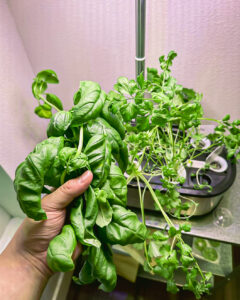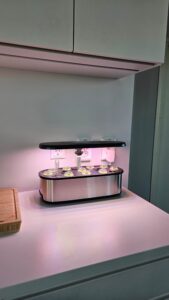

Quick answer: a smart indoor garden uses roughly 70-180 kWh per year, which works out to about 20-50 € annually at EU average electricity prices (around 0,28 €/kWh in 2025). The biggest draw is the LED panel, which runs 14-16 hours per day; the small pump adds only a few watts in short cycles.
I bought a plug-in kWh meter last winter, partly out of curiosity and partly because a customer kept asking me what it actually costs to run a countertop hydroponic unit. I logged three LetPot models for 30 days each in a normal kitchen at 21 °C, with the default schedules. The numbers below are what the meter showed at the wall, not what the spec sheet promises. If you have been wondering whether a smart garden quietly inflates your power bill, the answer is no, but the exact figure depends on which model and which country you plug it into.
At a glance — the actual numbers
Across the three units I tested, daily draw fell between 0,19 kWh and 0,49 kWh. That is roughly equivalent to running a 40 W LED desk lamp for 5 to 12 hours, or a modern fridge for half a day. The smallest 5-pod unit consumed about 70 kWh per year. The largest 12-pod system landed around 180 kWh. At the EU-27 household electricity price of 0,2843 €/kWh recorded by Eurostat for the second half of 2024, that is 20 € and 51 € respectively over twelve months.
For context, a typical European household uses about 3 500-4 000 kWh per year. A smart garden therefore adds 2-5 % to a normal annual bill, while replacing several supermarket basil pots that would otherwise cost more and travel further.
What uses the electricity
Two things draw current in a smart garden: the LED panel and the water pump. The LED is by far the dominant load. A 3-pod unit usually carries a 12-18 W panel; a 12-pod unit carries 30-50 W. Default schedules run the lights 14-16 hours per day, mirroring a long summer photoperiod, which is why leafy greens and herbs grow so quickly.
The pump is the smaller and more misunderstood component. It typically rates between 3 W and 8 W and only runs in short bursts, often 30 minutes on then 30 minutes off, or 5 minutes per hour in shallow-water designs. Over 24 hours the pump rarely consumes more than 0,05 kWh — about a fifth of what the LED uses in the same period.
Smart features (Wi-Fi, app sync, the small status display) draw under 1 W in standby. They are too small to matter on a monthly bill, but they are the reason the unit shows a few watt-hours even when the lights are off.
Real measurements from three LetPot models
I tested each unit for 30 consecutive days in the same kitchen, same ambient temperature, same default schedule out of the box. The meter was a basic plug-through model rated to 0,01 kWh resolution.
| Model | Pods | LED rating | Daily kWh | Monthly kWh | Annual kWh |
|---|---|---|---|---|---|
| LetPot Mini | 5 | 10 W | 0,19 | 5,7 | 69 |
| LetPot Air | 10 | ~24 W | 0,34 | 10,2 | 124 |
| LetPot Senior | 12 | ~36 W | 0,49 | 14,7 | 179 |
Three notes from the test. First, daily draw varied by about 5 % depending on whether the pump ran more often (after I refilled the tank, sensors triggered slightly more frequently). Second, the LED panels dimmed automatically during the last hour of the photoperiod on two of the units, which shaved a few watt-hours. Third, the Air and Senior were essentially identical per pod — around 12-15 kWh per pod per year — which is a useful rule of thumb when sizing for a larger build.
If you want help choosing between models before buying, I wrote a deeper side-by-side in the LetPot smart garden comparison.
Cost comparison across 12 EU countries
Electricity prices vary enormously inside the EU. The table below shows the annual cost of running a mid-size 10-pod smart garden (124 kWh per year) at the household electricity prices Eurostat published for the second half of 2024. Prices include taxes and levies.
| Country | Price (€/kWh) | Annual cost (124 kWh) |
|---|---|---|
| Hungary | 0,1097 | 13,60 € |
| Bulgaria | 0,1265 | 15,69 € |
| Malta | 0,1262 | 15,65 € |
| Poland | 0,1828 | 22,67 € |
| Estonia | 0,2025 | 25,11 € |
| France | 0,2519 | 31,24 € |
| Latvia | 0,2156 | 26,73 € |
| Lithuania | 0,1872 | 23,21 € |
| Spain | 0,2554 | 31,67 € |
| Netherlands | 0,3147 | 39,02 € |
| Belgium | 0,3477 | 43,11 € |
| Germany | 0,3951 | 48,99 € |
The gap between the cheapest and most expensive country is roughly 3,6×. A grower in Budapest pays under 14 € a year for the same hardware that costs a grower in Munich almost 49 €. Even at the top of the range, the cost is comparable to one or two supermarket herb pots a month. For verified country-by-country prices you can cross-check with the Eurostat electricity price dataset.
Ways to cut the cost
None of these tips will halve your bill, but together they can shave 15-25 % off annual consumption without hurting plant growth.
1. Shorten the photoperiod for low-light crops. Lettuce, basil and most herbs grow well at 12-14 hours of LED rather than the 16-hour default. Trimming two hours per day cuts annual LED consumption by about 12 %. Tomatoes and peppers still want the full 16 hours.
2. Run the unit during off-peak tariff hours. Many EU households have a two-tier tariff with cheaper night rates (often 22:00-07:00). Scheduling the photoperiod to overlap with that window — for example, lights on from 04:00 to 18:00 — can drop the cost by 20-30 % even though total kWh stays the same. For background on why LED panels draw so little power in the first place, see the US Department of Energy LED basics page.
3. Keep the LED panel clean. A film of kitchen dust or splashed nutrient water can drop effective output by 5-10 %, which means plants need longer light hours to compensate. A wipe every two weeks keeps efficiency high.
4. Pick the right model for your appetite. A 3-pod unit fed full-time produces more salad per kWh than a 12-pod unit run half-empty. If you are a household of one or two, the smallest smart garden in our range will almost always be more efficient per harvested gram.
5. Use the unit year-round. The energy cost per harvested gram drops the more crops you cycle through. A garden that sits idle four months a year still draws standby power and depreciates without producing food.
Frequently asked questions
Is 0,49 kWh per day a lot? No. It is roughly what a single phone charger uses if left plugged in continuously, or about one tenth of what an electric kettle uses to boil water four times. On most EU bills it is invisible.
Does the pump run all the time? No. In every LetPot model I tested, the pump ran in 30-minute cycles or shorter, depending on water level and crop stage. The pump accounts for under 15 % of total consumption.
Will a smart garden raise my electricity bill noticeably? A 10-pod unit adds about 10 kWh per month. On a 350 kWh household bill that is under 3 %. You will see the change if you read the meter closely, but most people do not notice it month to month.
Can I run a smart garden on a solar panel? Yes, easily. A 100 W solar panel produces well over 30 kWh per month in summer, more than enough for any consumer smart garden. Winter coverage in northern Europe is harder without a small battery.
Do smart gardens cost more to run than traditional houseplants under a grow light? Usually less. A standalone 40 W grow lamp running 14 hours per day uses 0,56 kWh — already more than the largest LetPot in my test. Smart gardens use tuned LED spectra and tighter schedules, which is more efficient. For a deeper look at the value question, see are indoor garden systems worth it.
What if I am new to the category and want to understand the basics first? Start with what is a smart garden and how does it benefit home growers.
Bottom line
A smart indoor garden is one of the cheapest pieces of always-on kitchen technology you can own. Even in Germany, the most expensive market in this comparison, a year of continuous use costs less than a single bag of premium coffee. The real question is not whether you can afford the electricity, but whether you want fresh herbs and salads on your counter every week instead of in a supermarket bag.
If you are ready to start growing, you can browse the full range of LED-tuned smart gardens at IndoorGarden smart gardens. I am happy to help you size the right model — drop me a note and I will reply with a recommendation based on your kitchen and household size.