Strawberry seeds grow most reliably indoors with a woodland strawberry (Fragaria vesca) type such as Regina — the RHS notes that this kind of seed germinates slowly and unevenly, sometimes taking up to 4 weeks, while the grower’s own data puts the first harvest at roughly 90 to 120 days after sowing.
Strawberries are not the first crop that comes to mind for an indoor garden, but woodland-type varieties stay compact and adapt to a pot or a hydroponic system just as well as lettuce or basil does. Unlike herbs, strawberries need a little more patience and a steady light schedule to reach their first harvest. This guide covers choosing the right seed, germinating it, how much light and water each growth stage needs, and when to expect the first red berries.
Products mentioned — in stock at IndoorGarden, shipped from Tallinn across the EU.


Why strawberries work well indoors
Most garden strawberry varieties are bred for a bed or a greenhouse and simply outgrow a pot. Woodland-type hybrids such as Regina are built differently: they are perennial, tolerate sun or partial shade, and the manufacturer’s own data puts the full cycle from seed to first harvest at 90 to 120 days. That makes them a reasonable fit for a windowsill pot or a hydroponic system, where light and moisture stay even all year rather than only through summer. The full range of varieties suited to indoor growing is in our strawberry seeds category.
Unlike leafy greens, which hand you a harvest week after week, strawberries are a several-month commitment, so it pays to start with a variety that is compact on its own and doesn’t need pruning to stay within a pot or system’s footprint.
Sowing and germination: what to expect in the first weeks
The Royal Horticultural Society notes that growing strawberries from seed applies specifically to woodland-type varieties, and that germination can be slow and uneven. Seeds are pressed onto the surface of moist compost rather than buried, since light helps trigger germination. The manufacturer’s data for the Regina variety lists a sowing depth of 0.5 cm and 20 cm spacing between plants once transplanted into a larger container. The first seedlings typically appear within 2 to 6 weeks, and a warmer, stable temperature speeds germination along.

Because germination is uneven, it is worth sowing several seeds at once and keeping only the strongest seedlings once they have 2 to 3 true leaves. The manufacturer lists a sowing window from February to July, which lines up with the fact that an LED grow light or a smart garden’s own lighting lets you start indoors in winter too, when sowing outdoors isn’t an option.
Light and temperature for growing strawberries indoors
The RHS explains that woodland strawberries tolerate both sun and partial shade — more flexible than large-fruited garden strawberries, which need full sun. Indoors that means a bright window is often enough, but through the Baltic region’s short, dark winter it usually isn’t. A smart hydroponic system’s built-in LED removes that problem automatically — manufacturers typically set it to run 12 to 16 hours a day regardless of how dark it is outside. A steady range of 18 to 24 °C suits the plant best; growth noticeably slows below 15 °C.
If the plant is growing on a windowsill without a supplemental light, move it closer to the glass in summer and back from the cold glass in winter, to avoid temperature swings in either direction. A safe overnight drop below the daytime value is fine; it’s a sharp swing of several degrees within a few hours, rather than the average temperature itself, that most often stalls flowering.
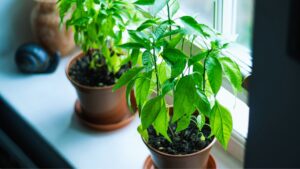
If you’re unsure whether windowsill light is enough, a quick visual check is the stem: a pale, stretched stem with widely spaced leaves points to too little light, while a compact, dark green plant with densely packed leaves shows the light is adequate. That visual check is faster than hunting down a light meter and works fine for just a few plants.
Watering and feeding through the growing season
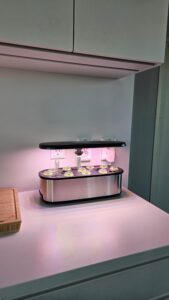
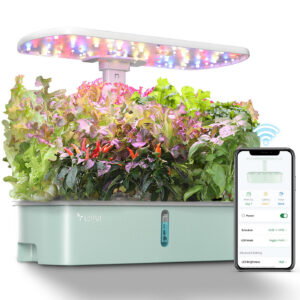
Strawberries tolerate neither drying out nor staying constantly wet — both slow root activity and can reduce flower numbers. In a pot, water once the top 2 cm of compost is dry, and avoid letting water sit in the saucer underneath. In a hydroponic system such as the LetPot Air, the reservoir keeps the root zone evenly moist automatically, which is one reason strawberries often do better in hydroponics than in a pot of compost.

Early on the plant draws mostly on nitrogen for leaf growth, but once the first flowers appear, manufacturers typically recommend switching to a solution higher in potassium and phosphorus, which supports flowering and fruit set. A ready-made hydroponic nutrient solution can be added straight to the reservoir at a controlled dose, which is simpler than measuring out feed by hand in a pot.
Pollination and the first harvest
Indoors there is no wind and no insects to carry pollen naturally from one part of a flower to another, so a flower can finish blooming without setting fruit if nothing is done. The fix is simple: every day or two, touch the inside of each open flower with a soft brush or cotton swab, or gently tap the stem. It’s the same technique chilli and tomato growers use indoors, and it takes under a minute per plant.
According to the manufacturer’s data, the first harvest on the Regina variety is typically expected 90 to 120 days after sowing, with the fruiting period running from July to September when sown in spring. Indoors with steady light, that window can be stretched or shifted to a different season, since the plant doesn’t depend on the natural day-length cycle to start flowering.
Strawberries in a pot versus a hydroponic system
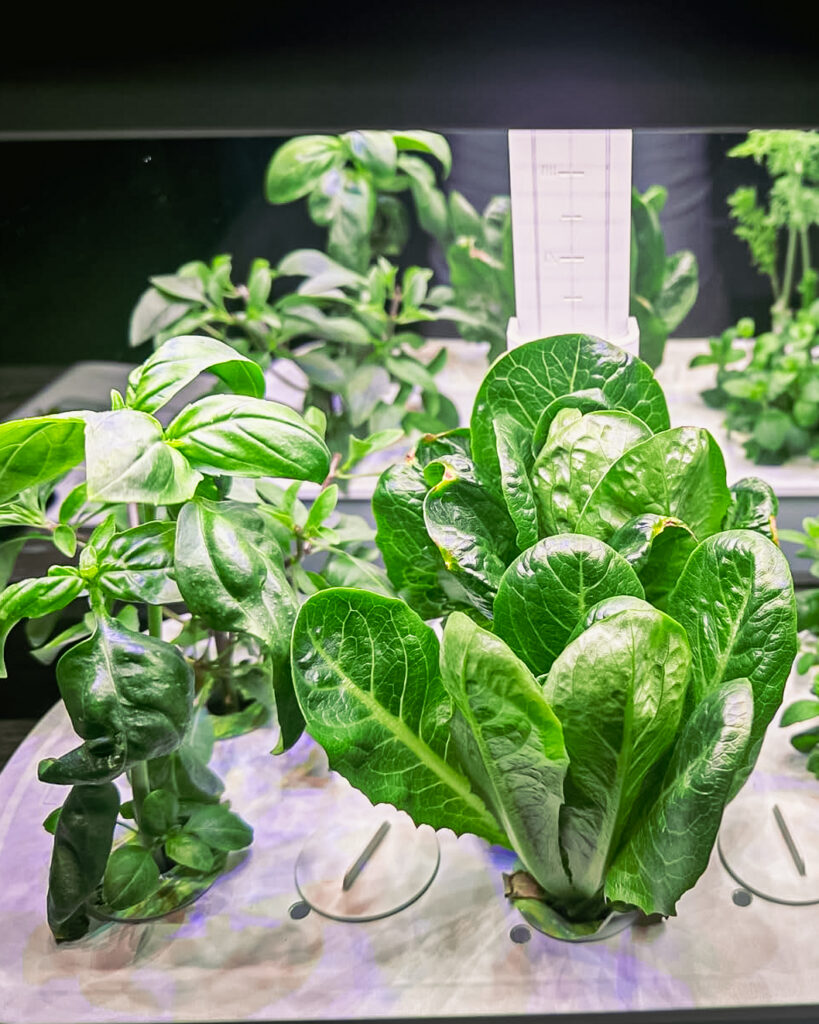
In a pot of compost, strawberries need regular watering checks and a feed dose reviewed every couple of weeks — a good fit for someone who likes to stay hands-on with a plant. In a ready-made smart garden, the light schedule, water level and nutrient solution run on a set cycle, leaving pollination as the one thing you still do by hand. Larger systems with several pod slots can grow strawberries alongside herbs or lettuce when the light height is adjustable per plant.
Which system suits which grower: a quick comparison
The table below sums up what each product does and when it’s worth using for growing strawberries indoors.
| Product | What it does | Best for | Price |
|---|---|---|---|
| Strawberry “Regina” seeds | Woodland-type seed for a pot or hydroponics | A first attempt at growing strawberries indoors | €1.99 |
| LetPot Air (10 pods) | Full smart hydroponic system with built-in LED | Steady light and watering all year round | €89.00 |
| LetPot liquid nutrient solution | Ready-made feed for the flowering and fruiting stage | Hydroponic feeding without hand-mixing | €17.99 |
Frequently asked questions
How long does it take from strawberry seed to first harvest?
The manufacturer’s data for the Regina variety lists 90 to 120 days, given steady light and a temperature of 18 to 24 °C. Germination alone can take up to 4 weeks, so the total time from sowing to the first berry can stretch to around 4 months.
Can strawberries be grown in a smart hydroponic garden?
Yes. The automatic light and watering suit strawberries just as well as herbs, though pollination indoors still has to be done by hand, since there are no insects inside the system.
Why won’t my strawberry seeds germinate?
The most common reason is burying the seed in compost — strawberry seeds need light to germinate, so they should sit on the surface rather than be covered. Uneven moisture in the first few weeks is the other common cause.
Do strawberries need direct sunlight indoors?
No. The RHS notes that woodland strawberries tolerate both sun and partial shade, and indoors a full-spectrum LED replaces natural daylight entirely if there isn’t enough of it.
How can I tell a pollination problem apart from something else going wrong?
A flower opens, stays open for several days and then drops without any fruit forming behind it — that’s a sign of missing pollination rather than disease. If the leaves stay healthy and green, the cause is almost always this.
Are indoor strawberries perennial?
The manufacturer’s data confirms the Regina variety is perennial, so one well-kept plant can produce a harvest across several seasons rather than just one year.
Do strawberries indoors need a large pot?
No, a small pot or a hydroponic pod is enough for the first few months, since the root system stays compact. Once the plant establishes and puts out more leaves, moving it to a larger container, or a pot at least 15 to 20 cm across, supports a better harvest.
Where to start
The simplest way in is Regina strawberry seeds — sow them on the surface of moist compost and give them a stable, warm spot to germinate. If you’d rather automate the whole process from day one, our seeds and smart gardens categories have everything you need in one place. Everything ships from our Tallinn warehouse across the EU.