To grow rosemary indoors through winter, give it 6 to 8 hours of direct sun or 12 to 14 hours under a grow light, keep the room cool at 4 to 16 °C and water only once the top 2 to 3 cm of soil has dried. Most winter rosemary deaths come from dark rooms and wet roots, not cold.
I brought my first rosemary inside one October full of confidence, and by January it was a brown skeleton. The second and third went the same way before I understood what the plant was actually asking for. Rosemary has been the most requested herb in our customer emails every winter since IndoorGarden started, and the questions are always the same ones I once had. So here is the full winter routine I use now, and the reasons behind every step of it.
Why rosemary dies indoors, and it is rarely the cold
Rosemary is an evergreen Mediterranean shrub that tolerates surprising cold, surviving down to roughly −7 °C, which is why a garden plant in Spain or Portugal shrugs off winter while the same plant dies in a warm Baltic living room. The NDSU Extension names root rot as the main issue with rosemary grown inside, and my own three dead plants all fit that diagnosis. Indoors the plant faces a combination it never meets outdoors: weak light, warm dry air and a well-meaning owner with a watering can. The fix is to rebuild its Mediterranean winter on a windowsill, which is bright, cool and on the dry side.
Light is the non-negotiable part
Rosemary is a full-sun plant that wants 6 to 8 hours of direct light a day, and that is exactly what northern Europe cannot offer between October and March, when even a south-facing window often delivers fewer than 4 weak hours. The University of Minnesota Extension classifies culinary herbs like rosemary and thyme as high-light plants needing the equivalent of more than 20 W of efficient lighting, and under artificial light the day should stretch to 12 to 14 hours to compensate for the lower intensity. In practice that means a south window plus a small LED panel on a timer, or a spot under any decent unit from our grow lights collection. If you want to calculate the light dose properly instead of guessing, my explainer on DLI and how much light plants actually need walks through the numbers.
Water less, but never to bone dry
Overwatering kills more indoor rosemary than everything else combined, because cool, slow-growing winter roots sit in wet soil for days and rot. My rule is the finger test: water only when the top 2 to 3 cm of soil feels dry, which in a cool room works out to roughly every 7 to 10 days. The counterweight matters too, since rosemary has no drought tolerance in a pot, and foliage that dries out completely does not recover. An unglazed clay or terracotta pot helps on both ends by letting the root zone breathe and excess moisture evaporate through the walls, and the pot must have a drainage hole. I skip fertiliser almost entirely from November to February, since a resting plant cannot use it.
Cool, bright and breezy beats warm and cosy
The ideal winter spot for rosemary is 4 to 16 °C, which describes an unheated bedroom, a glazed balcony or a bright stairwell far better than a living room at 22 °C. Heat plus weak light produces the classic leggy, pale winter growth that flops over and invites pests. Dry radiator air causes a second problem, browning needle tips, and a shallow tray of pebbles and water under the pot raises local humidity enough to help. Air movement is the detail almost everyone skips: rosemary in still indoor air develops powdery mildew quickly, so I crack a window on mild days or run a small fan nearby for an hour, and the white film has never returned.
Winter trouble table
| Symptom | Likely cause | Fix |
|---|---|---|
| Needles dropping in handfuls | Too little light | Grow light on a 12–14 h timer |
| Black stem base, sour smell | Root rot from overwatering | Repot into dry mix, water by finger test |
| White powdery film on needles | Still air and high humidity | Airflow, more space around the plant |
| Pale, stretched new shoots | Too warm with too little light | Move to a cooler, brighter spot |
| Crispy brown tips | Radiator air, drought | Pebble tray, move off the heat source |
Harvest with a light touch until spring
A winter rosemary runs on a fraction of its summer energy, so I take soft green tips only, a few centimetres at a time, and never more than a quarter of the plant across the whole season. Cuts into bare wood do not regrow at any time of year, and in winter even heavy tip harvesting can stall the plant for a month. The full technique, including where to cut on woody herbs, is in my guide on harvesting herbs without killing the plant.
Starting fresh from seed is slow but satisfying
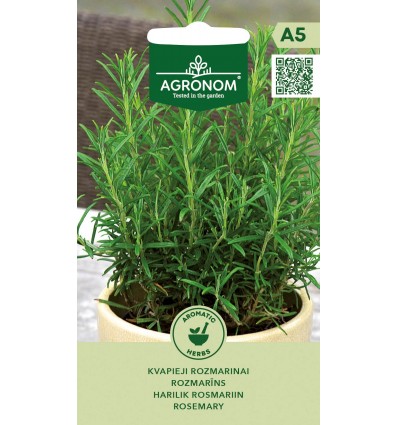
Rosemary from seed asks for patience, since germination takes 2 to 4 weeks even in warm conditions and the rates are modest compared with basil or dill. I sow generously, keep the tray at 20 to 25 °C and expect to wait. The reward is a plant adapted to your conditions from day one, and a packet of rosemary seeds costs a fraction of a nursery shrub. A hydroponic smart garden sidesteps the whole winter problem, since the built-in light runs 12 to 14 hours regardless of the season and the water level is managed for you. I have answered the most common version of that question separately in our FAQ on whether rosemary grows indoors.
Frequently asked questions
How much light does rosemary need indoors in winter?
The equivalent of 6 to 8 hours of direct sun. Under a grow light, run 12 to 14 hours daily on a timer, since artificial light is less intense than midday sun and the longer day makes up the difference.
Why is my rosemary dropping needles?
Heavy needle drop in winter almost always means light starvation, and the plant is shedding foliage it can no longer feed. If the stem base is also dark and soft, suspect root rot instead and check the roots the same day.
How often should I water rosemary in winter?
Only when the top 2 to 3 cm of soil is dry, which is usually every 7 to 10 days in a cool room. In a warm room with a grow light it may be every 4 to 5 days. The schedule follows the soil, not the calendar.
Can rosemary grow in a hydroponic smart garden?
Yes, and winter is where the system shines, since light and moisture are handled automatically. Germination stays slow at 2 to 4 weeks, so start the pod earlier than your other herbs and let the taller systems with 70 cm or more of grow height take over as the plant matures.
What temperature does rosemary want in winter?
Cool, ideally 4 to 16 °C. A bright unheated room beats a warm living room, because cool air slows growth to match the weak winter light. Just keep it above freezing, with a safety margin from about −5 °C.
Can I move it back outside in spring?
Yes, gradually. From April, give it warm days outdoors and bring it in at night for a week or two, keeping it out of direct midday sun at first. Harden it off the same way you would a seedling.
Give it a Mediterranean winter, not a tropical one
Everything above compresses into one sentence: keep rosemary bright, cool and slightly dry, which is the opposite of the warm, dim, well-watered corner most plants get. Winter is also when a proper light pays for itself across every herb on the sill, and you can compare panel sizes and wattages in our grow lights for indoor plants range. The plant that finally made it through to March for me is now four winters old and the size of a small hedge.