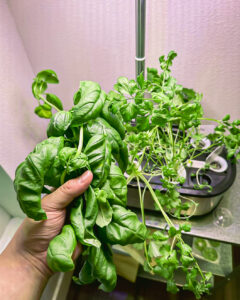
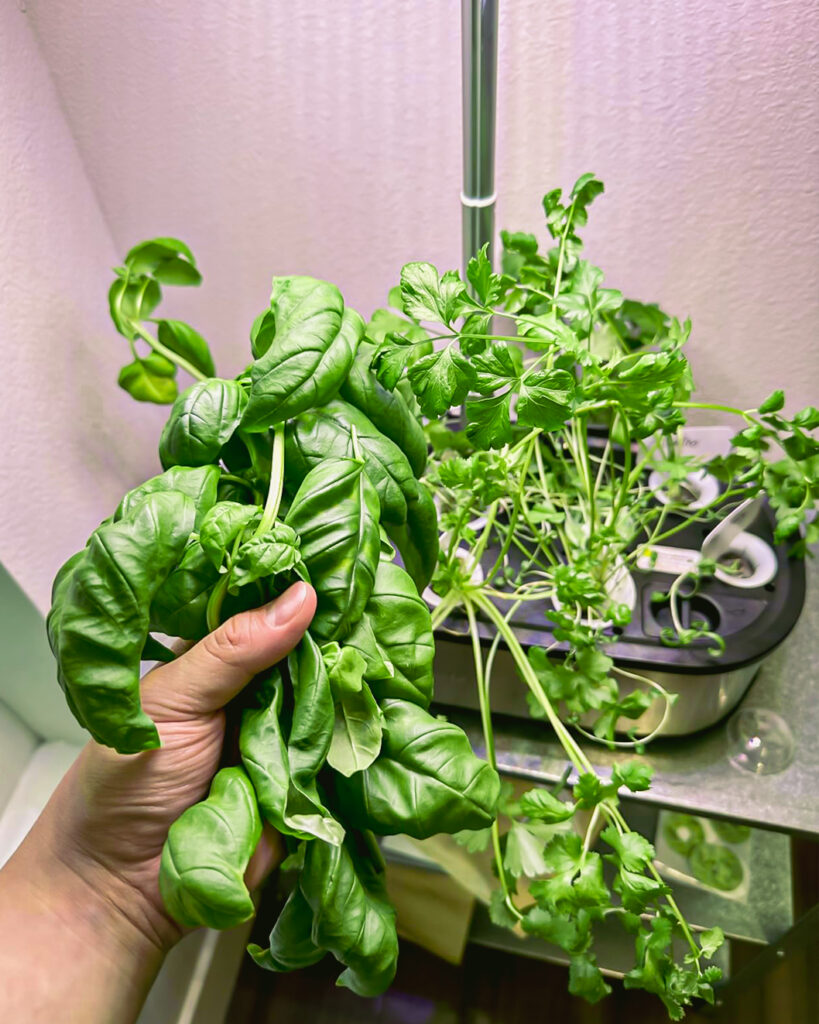
To harvest herbs without killing the plant, never remove more than a third of the foliage at once and cut in the right place: just above a leaf pair on stem herbs like basil, at the base of the outer stalks on parsley and dill, and 2–3 cm above the base on chives.
I killed my first basil the way most people do: by plucking the big lower leaves one by one until a bare stick was left. The plant never recovered, and at the time I had no idea why. Fifteen years of indoor growing later, harvesting is the part I enjoy most, because done right it makes plants bushier and more productive instead of weaker. Here is exactly where to cut on each herb we grow, how much you can take and the handful of mistakes that actually kill plants.
The one-third rule comes first
The one-third rule is the single habit that keeps harvested herbs alive: take no more than a third of the plant’s leaves or stems in one session, then let it recover. Leaves are the plant’s engine, and stripping more than 30 percent at once leaves too little surface to power regrowth. Most healthy herbs rebuild within 7 to 14 days, after which you can harvest again. Timing helps too. The University of Minnesota Extension recommends picking in mid-morning, after the dew dries but before the heat of the day, because that is when the aromatic oil content in the leaves peaks. Wait until a young plant is at least 15 cm tall before its first proper harvest, which usually means 4 to 6 weeks after sowing.
Stem herbs: cut just above a leaf pair
A stem herb is one that grows upward on a central stalk and branches after cutting, and this group includes basil, peppermint, oregano and thyme, all members of the mint family. Cut the stem a few centimetres down from the top, always just above a pair of leaves. Two new shoots emerge from that point, so every correct cut doubles the number of growing tips. Pinching the top 3–5 cm every week or two keeps basil compact and delays flowering, and that matters because basil turns bitter and woody once it sets seed. If flower buds appear, pinch them off the same day. The same top-down logic applies when a plant outgrows its light: I cover that in my guide to pruning tall plants to fit a smart garden.
Rosette herbs: take outer stalks at the base
A rosette herb grows its stalks from a central crown instead of a stem, and here the harvest direction is the exact opposite. Parsley, dill and coriander belong to the carrot family, and the right cut is each outer leaf stalk at its base, working from the outside in. The centre is the growing point, so as long as you leave it untouched, new stalks keep rising from the middle for months. Cutting the young centre stalks instead is the classic parsley-killing mistake. Chives work on the same principle with one tweak: snip whole leaves 2–3 cm above the base rather than plucking tips, and the cut leaves regrow from the bottom like grass.
Woody herbs: trim soft tips, never cut into bare wood
A woody herb builds permanent stems that thicken with age, and rosemary and sage are the two we grow most. Harvest 5–8 cm of soft green tip growth and stop there. Old bare wood has no dormant buds on most rosemary varieties, so a cut into the leafless brown section simply never regrows. With woody herbs I also stick to the gentler end of the one-third rule, closer to a quarter of the plant, because they rebuild more slowly than basil or mint. Penn State Extension notes that indoor herbs generally grow less vigorously than outdoor ones, so a windowsill rosemary needs longer recovery pauses than the same plant on a summer balcony.
The cheat sheet
| Herb | Where to cut | Maximum per harvest | Regrowth time |
|---|---|---|---|
| Basil | Above a leaf pair, top 3–5 cm | One third | 7–10 days |
| Peppermint, oregano, thyme | Above a leaf pair | One third | 7–14 days |
| Parsley, dill, coriander | Outer stalks at the base | One third of stalks | 10–14 days |
| Chives | 2–3 cm above the base | One third of leaves | 10–14 days |
| Rosemary, sage | Soft green tips, 5–8 cm | One quarter | 2–4 weeks |
If you are still deciding what to grow in the first place, my overview of which herbs grow well indoors ranks all of these by difficulty.
Clean tools beat fingers for almost everything
Soft basil tips snap off cleanly between a thumbnail and finger, and for daily pinching that is fine. For everything else I use small, sharp scissors, because a clean cut heals in a day or two while a crushed or torn stem stays open and invites rot, especially in the humid environment of a hydroponic system. A dedicated pair of indoor pruning scissors like the Fiskars SP15 snip costs little and stays sharp for years. Wipe the blades after cutting anything diseased, and never harvest wet plants if you can avoid it, since water spreads spores from leaf to leaf.
Frequently asked questions
How often can I harvest basil?
Every 7 to 10 days once the plant is established, taking up to a third each time. In a smart garden with 12 to 14 hours of daily light, regrowth runs at the faster end of that range year-round.
Why did my parsley die after harvesting?
Almost always because the central young stalks were cut instead of the outer ones. The centre is the growing point. Take the oldest outside stalks at the base and the plant keeps producing for months.
Should I harvest before or after flowering?
Before. Leaf flavour peaks just before flowering and declines afterwards, and annual herbs like basil, dill and coriander begin shutting down once seed production starts. Pinch flower buds off the moment you see them.
Does harvesting work the same in a hydroponic smart garden?
The cutting technique is identical, but everything runs faster. Plants under a constant light schedule regrow in roughly two-thirds of the usual time, so a smart-garden basil tolerates weekly harvesting that would exhaust a windowsill plant.
Do herbs always grow back after cutting?
Only if the growing points survive. Stem herbs regrow from leaf nodes, rosette herbs from the central crown and chives from the leaf base. Cut below every node, into the crown or into bare wood, and there is nothing left to regrow from.
When can I start harvesting a newly sown herb?
Once it reaches about 15 cm with several true leaf pairs, typically 4 to 6 weeks after sowing. Earlier picking stalls young plants, since they have so few leaves that every one counts.
Harvest more, not less
The counterintuitive part of all this is that regular correct harvesting makes herbs fuller, not emptier, because every good cut multiplies the growing tips. So cut confidently, just in the right places. If your kitchen needs more raw material to practise on, you will find every herb in this guide in our herb seeds collection, from basil to sage.