Quick answer: the 7 most common smart garden problems are algae growth, pump noise, slow plant growth, yellowing leaves, app or light glitches, white mineral film on pods, and sponge mould. Every one of them has a fix that takes me under 10 minutes, and most of them I now prevent without thinking.
I have been running smart gardens at home for the last 18 months. Two LetPot units, plus a third one I move around for testing. In that time I have lost exactly one harvest, and that was an early basil run I drowned in nutrients during week one. Everything else, every weird noise and weird leaf, turned out to be a small, fixable thing. This is the troubleshooting checklist I wish someone had handed me on day one, sorted by how often the problem actually shows up in my kitchen.
The 7 problems at a glance
| Problem | Most likely cause | My fix time | Prevent it next time |
|---|---|---|---|
| Green algae on reservoir walls | Light reaching the water | 8 minutes | Cover any gap with the lid or tape |
| Pump rattling or buzzing at night | Low water or pump intake clogged | 3 minutes | Top up weekly, rinse pump monthly |
| Plants growing slowly | Weak nutrients or short light hours | 5 minutes | Check EC every 2 weeks |
| Yellow lower leaves | Nitrogen low or pH drift | 6 minutes | Refresh full reservoir every 2 to 3 weeks |
| Light or app not responding | Power blip, Wi-Fi drop, firmware | 4 minutes | Use a smart plug as a hard reset |
| White crust on pods and rim | Hard water, evaporation salts | 5 minutes | Top up with low-mineral water |
| Mould on grow sponges | Wet sponge, no airflow, old seeds | 2 minutes per pod | Trim husks, keep room air moving |
Algae in the reservoir
The first time I lifted the lid and saw a green ring around the inside of my reservoir, I assumed something was very wrong. It was not. Algae need three things to bloom: water, nutrients, and light. The first two are non-negotiable in a smart garden, so the only lever I have is light. A 1995 ISHS peer-reviewed study on algae in hydroponics flagged this exact issue and concluded that excluding light from the reservoir is safer than using algicides, which tend to be phytotoxic on edible crops. That matched my experience to the letter.
My 8-minute fix: I unplug the unit, lift the lid, pour the old solution out, and wipe the inside with a 1:10 white vinegar solution and a soft cloth. I rinse twice with clean water, refill with fresh nutrient solution, and check that the lid sits flush. If I can see a slit of light hitting the water when the LEDs are on, I cover it with a strip of black electrical tape. Algae growth slows down dramatically once the reservoir is back in the dark.
The prevention habit I picked up: every time I top up water, I look at the seal around the lid. New cracks, missing rubber, a pod that does not click in properly. Those are the gaps that grow algae a week later. If you want to dig deeper into how nutrient strength changes the picture, I wrote a separate piece on EC and how much nutrient solution to add.
Pump noise at night
My kitchen is open to the living room, so a buzzing pump at 11pm is not acceptable. Smart garden pumps are tiny, normally 1 to 3 watts, and they should sound like a soft hum, not a rattle. If the noise changes character, the pump is telling you something. In 18 months I have heard three distinct sounds, and each one means a different thing.
- High-pitched whine: water level is too low and the pump is half-sucking air. Top up to the max line.
- Clicking or rattling: debris, a stray root, or a piece of sponge has lodged near the impeller. Unplug, lift the pump, rinse under the tap.
- Deep buzz that vibrates the unit: the pump foot has come loose from its rubber dampener. Reseat it.
My 3-minute fix for a clogged pump: unplug, lift the lid, pull the pump out by its cable strain relief, rinse the intake under running tap water for 30 seconds, gently squeeze the impeller cover, and drop it back into the reservoir. Plug it back in. If the noise is gone, you are done. If not, it is usually scale build-up, and a 15-minute soak in 1:5 white vinegar followed by a fresh-water rinse sorts it. Pump replacements are cheap when the time comes, and I keep a spare from the smart garden accessories range so I never lose a harvest waiting on shipping.
Low yield or slow growth
This is the most emotionally frustrating problem on the list, because nothing is obviously broken. The plants are alive, the lights are on, the pump is running, and yet at week 4 my basil looks like it should look at week 2. Nine times out of ten, the cause is one of three things, and I check them in this order.
- Light hours: leafy greens want 14 to 16 hours of light a day. If the app reset after a power blip and went back to a 12-hour default, growth slows. I open the app and confirm the schedule.
- Nutrient strength: EC drops as plants drink. If I have not refreshed the solution in 3 weeks, I either dump and refill, or top up with a half-strength dose.
- Water temperature: above 24°C and roots struggle to take up oxygen. I move the unit away from sunny windows or radiators.
My 5-minute fix when growth stalls and I cannot pin it down: I do a full reservoir refresh. Dump the old solution, wipe the tank, refill to the line, add the dose of nutrients the manual recommends for the pod count, set the schedule back to 16 hours. Within 4 days the plants almost always start moving again. If you are new to the EC number itself, the guide on EC in hydroponics walks through the target ranges by crop.
Yellowing leaves
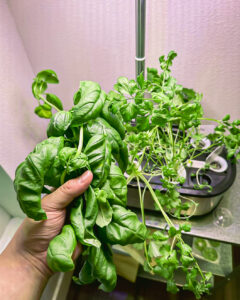
Yellow leaves on a smart garden plant are almost always a nutrient or pH story. The pattern of the yellowing tells me which one. Lower leaves yellowing first while new growth stays green: classic nitrogen shortage, which means the solution is old or too dilute. Yellow between the veins on younger leaves: pH has drifted, and the plant cannot pull iron and magnesium out of the water even though they are present.
My 6-minute fix: I refresh the entire reservoir. Old solution out, tank wiped, fresh nutrients in at the dose printed on the bottle for the current pod count. If I have a pH test strip or meter on hand, I aim for 5.5 to 6.5, which is where the UMN small-scale hydroponics guide places the safe range for home growers. If I do not have a meter, fresh tap water plus fresh nutrients almost always lands inside that band, because the smart garden mix is buffered.
One detail that saves me time: I do not try to rescue badly yellowed lower leaves. I snip them off at the stem with clean scissors. New growth comes in faster when the plant is not spending energy on a dying leaf. For a step-by-step on shaping a smart garden plant rather than just feeding it, the piece on what a smart garden is and how it benefits home growers covers the basics of pod management.
Light not turning on or app issues
Electronics are the smallest category of problem I see, but they are the most stressful because they feel unfixable. Out of dozens of incidents, exactly one was a hardware failure. The other 30-odd were Wi-Fi drops, firmware glitches, or a power blip that wiped the schedule. My rule: before I email support, I run a 4-minute reset routine.
- Unplug the unit at the wall. Wait 60 seconds. Plug it back in.
- Open the app, force-close it, reopen.
- Check the schedule. If it is back to default, set it to 16 hours of light and save.
- If the LEDs still do not respond, hold the manual power button on the unit for 10 seconds to do a hard reset.
That routine fixes around 95% of what I see. A trick I have started using: I plug the smart garden into a cheap smart plug. When the app cannot reach the unit, I cycle the plug from my phone instead of crawling behind the kitchen counter. If the unit has been running for over a year and the LEDs are dimming evenly, that is wear on the diodes, and a replacement light panel is the cleaner fix than chasing app settings. The FAQ on which LetPot parts wear out and can they be replaced lists what is actually swappable.
White mineral film on pods
Estonian tap water is fairly hard. Within a month, I see white crust at the waterline on the pod baskets and on the rim of the reservoir. It is harmless to the plants in the short term, but it slowly clogs the pump intake and the sensor, and if it builds up under a pod, the seed does not germinate properly. I treat it as a monthly cleaning task, not an emergency.
My 5-minute fix: at every full reservoir refresh, I wipe the pod baskets and the inside rim with a cloth soaked in 1:5 white vinegar, then rinse with clean water. The film comes off in one pass. For prevention, I have started topping up with low-mineral water, ideally filtered or bottled spring water, rather than straight tap. That alone has slowed the scale build-up by maybe half.
If you live in a hard-water area and you are doing 2 to 3 smart gardens at once, a basic carbon water filter on the kitchen tap pays for itself in scale you do not have to scrub. I rotate consumables and check inventory against the smart garden accessories shelf, so I never run out of fresh sponges or nutrient mix mid-cycle.
Sponge mould
Mould on grow sponges is the problem I used to panic about and now barely register. White fuzz on the top of a sponge in the first 7 days is usually root hair, not mould, and disappears once the seedling roots dive down. Actual mould is fluffier, sometimes greenish or grey, and it spreads if I do nothing.
My 2-minute-per-pod fix: I pull the affected pod out, trim any visible mouldy material off the top of the sponge with scissors, rinse the sponge gently under cool tap water, and slot it back in. If the seedling itself looks damaged, I bin the pod and start a new one. Three habits cut mould incidents to almost zero in my setup: I trim the husk fragments off seed pods before installing them, I keep airflow in the room with a cracked window or a small desk fan, and I do not overfill the reservoir so the sponge stays soggy on top.
Frequently asked questions
How often should I clean my smart garden reservoir?
Every 2 to 3 weeks for me. Full dump, wipe with diluted vinegar, rinse, refill. Plants drink steadily, so the nutrient profile drifts even if the water looks clean.
Can I use tap water in a smart garden?
In most parts of Estonia and the wider EU, yes. Let it sit uncovered for an hour to off-gas chlorine. If your tap water is very hard or heavily chlorinated, filtered water is gentler on the pump and the pods.
Is white fuzz on a new pod always mould?
No. In the first 7 days it is usually root hair, which is white, fine, and short. Mould is fluffier and tends to look greenish or grey. Wait a day before acting, and check again.
Why are my plants growing slower than the manual promises?
Check three things in order: light schedule (should be 14 to 16 hours), nutrient freshness (under 3 weeks old), water temperature (under 24°C). Fixing one of those usually restarts growth within a few days.
Should I bleach a smart garden reservoir to kill algae?
I do not. White vinegar at 1:10 with water cleans gently and leaves no residue once rinsed. Bleach risks harming the pump seals and contaminating the next batch of edible plants.
When to call it and start fresh
After 18 months I can tell within two days whether a smart garden problem is a fix or a reset. If two of these are true at the same time, I drain the whole unit, scrub it, and start a new cycle: persistent algae after three cleanings, root rot smell, more than half the pods failing to grow, or visible scale that does not come off with vinegar. Starting fresh costs me one afternoon and a new set of pods, and it saves me weeks of nursing a sick garden back.
The bigger lesson from 18 months of running these units: smart gardens are not maintenance-free, they are predictable-maintenance. Twenty minutes a fortnight on water, nutrients, and a wipe-down, and I get herbs and salad on the counter year-round. If you are weighing up which model fits your kitchen, the full smart gardens range shows the sizes side by side, and the parts I rely on for cleaning and replacement live in smart garden accessories.