To grow basil indoors, sow seeds about 5 mm deep in a moist substrate, keep them at 20–25 °C and give the seedlings 14–16 hours of full-spectrum light a day. Germination takes 5–7 days, the first real harvest comes after 4–6 weeks, and a plant you pinch regularly will keep producing for months.
Basil was the first herb I killed indoors, and it taught me more than any plant that survived. More than ten years later I pick fresh basil in my kitchen in February, while it is -15 °C outside the window. Nothing about that is exotic. Basil has a short list of needs that are easy to miss, and once you cover them it grows faster indoors than it ever would in a Baltic summer. Here is what actually matters, in the order it matters.
Why basil suits indoor growing in northern climates
Basil is a tender annual from the mint family that stops developing below roughly 8 °C and speeds up steadily as temperatures climb towards 29 °C. That biology explains almost everything about it. An Estonian summer gives basil maybe three safe months outdoors, while a normal heated home sits at 20–23 °C every single day of the year. Indoors, temperature is solved by default. The two things left for you to manage are light and harvesting technique, and both are simpler than they sound. I have grown basil on windowsills, under standalone grow lights and in hydroponic smart gardens, and the plant wants the same conditions everywhere.
Choosing basil seeds that work indoors
A good indoor basil is a compact, leafy variety that stays somewhere between 20 and 50 cm tall and bolts slowly. Classic Genovese-type sweet basil ticks every box, which is why it is the standard choice for pesto, tomato dishes and most European kitchens. My default is Sweet Basil Italiano Classico, a reliable Genovese type that germinates evenly and regrows quickly after cutting, and I rotate in Marseillais when I want a slightly sweeter leaf. You will find both among our basil seeds. One packet holds far more seeds than a household needs at once, so sow a small batch every 4–6 weeks instead of everything at once. That staggered rhythm is the real secret to a year-round supply.
Light is the one requirement basil will not negotiate
Daily light integral, or DLI, is the total amount of light a plant receives over 24 hours, and for basil it is the single best predictor of how much you will harvest. Research at Iowa State University found that raising DLI from 7 to 15 mol/m²/day increased the fresh mass of sweet basil by 144 percent, so the plants more than doubled. A south-facing window delivers enough from roughly May to August. From October to March at Baltic latitudes it delivers a fraction of what basil wants, which is why windowsill basil quietly stalls in autumn. The fix is unglamorous: a full-spectrum LED on a timer, 14–16 hours a day, positioned 10–20 cm above the leaves. Every smart garden has this built in. If you want to understand the numbers behind light planning, I broke them down in what DLI is and how much light plants need.
Temperature, water and nutrients
The comfortable range for indoor basil is 18–25 °C, and steady matters more than warm. Keep pots away from cold glass in winter, because a single night below 10 °C is enough to blacken leaves, and away from radiators, which dry the substrate in hours. Water in the morning rather than the evening, since basil dislikes sitting in wet substrate overnight. The RHS growing guide gives the same advice. In soil, water when the top 2 cm feel dry, and feed with a balanced liquid fertiliser at half strength every 4–6 weeks, which is the rate the University of Minnesota Extension recommends for indoor basil. Skip high-potassium tomato feeds, because they push basil towards flowering. In a hydroponic system, simply add nutrients when you refill the tank and keep the water around pH 6.0–7.5.
Sowing basil step by step
This is the routine I use for every batch, whether the destination is a 20 cm pot or a smart garden pod.
- Moisten the substrate first. A pre-soaked sponge pod or evenly damp potting mix germinates far better than one watered after sowing.
- Sow 3–5 seeds per pot about 5 mm deep, or 2–3 seeds per hydroponic pod. Basil seeds are tiny, so do not bury them deeper.
- Cover with a humidity dome or a clear bag and hold 20–25 °C. Warmth speeds everything up.
- Expect germination in 5–7 days. Remove the cover as soon as you see green loops breaking the surface.
- Switch on the light: 14–16 hours daily from day one prevents leggy, stretched seedlings.
- Thin to the one or two strongest seedlings per pot or pod once the first true leaves appear.
- Pinch the growing tip when the plant has three pairs of true leaves, at roughly 10–15 cm height. This first pinch decides whether you get a single stalk or a bush.
Windowsill pot or smart garden: what to expect
Both routes work, and I run both at home. The difference is speed and attention, not leaf quality.
| Windowsill pot | Hydroponic smart garden | |
|---|---|---|
| Germination | 5–10 days, slower in cool rooms | 4–7 days at a steady 20–24 °C |
| First harvest | 5–6 weeks | around 4 weeks |
| Winter growth | Stalls without a grow light | Unchanged, light is built in |
| Watering | Every 2–3 days by hand | Tank refill every 1–2 weeks |
| Effort | Daily attention | A few minutes a week |
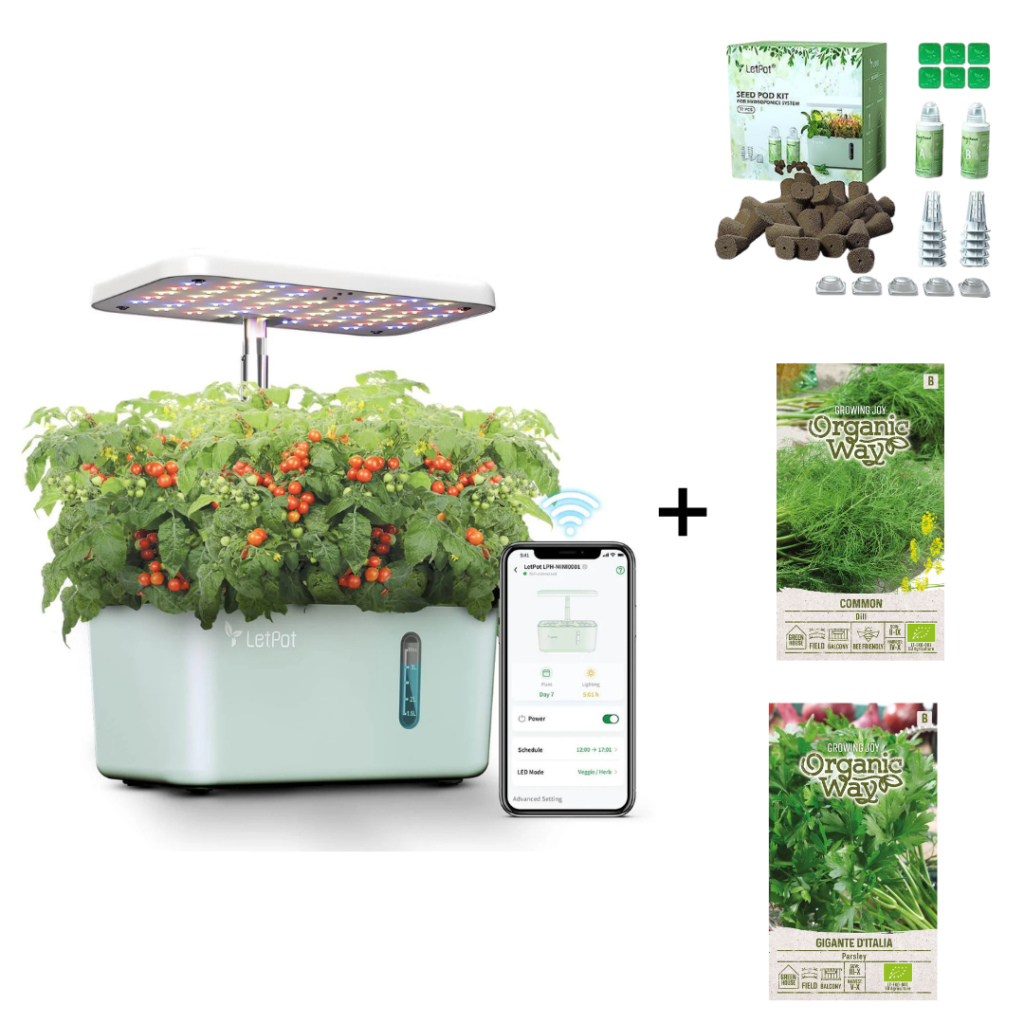
If you want the low-effort route, a compact unit such as the LetPot Mini runs five pods on a kitchen-counter footprint and handles light and watering on its own. My kitchen unit has produced basil continuously since 2023 with nothing but refills, nutrients and pinching.
Harvesting so one plant keeps producing
Correct basil harvesting is pruning, not plucking. Cut a stem just above a pair of leaves and two new shoots grow from that junction, which is how a plant doubles its branches with every harvest. New growth is usually visible within a week. Take shoot tips first, never strip the large lower leaves that power the plant, and never remove more than a third of the foliage at once. Pinch out flower spikes the moment you see them, because flowering turns the leaves bitter and the stems woody. With a weekly pinch-and-pick rhythm, a single sowing gives me 2–3 months of steady harvests before the plant tires and the next batch takes over. Freeze any surplus, chopped into an ice-cube tray with a little water or oil, because basil keeps its flavour frozen far better than dried.
Frequently asked questions
Why are my basil leaves turning yellow?
The usual causes, in order: overwatering, cold and hunger. Let the top 2 cm of substrate dry between waterings, keep the plant above 15 °C and away from cold glass, and feed monthly if it has lived in the same pot for more than six weeks. Yellowing that starts on the lowest leaves while the top stays green usually points to a nitrogen shortage.
Why does supermarket basil die so quickly?
A supermarket pot is not one plant but 20 or more seedlings crammed together to look full on the shelf. They exhaust the tiny pot within days. Divide the clump into 3–4 smaller bunches, pot each into its own container, water them and give them strong light. A good share will recover and produce for weeks.
Can I grow basil indoors all year round?
Yes, with one condition: 14–16 hours of light a day, which in northern winters means a grow light or a smart garden. Basil stays an annual indoors, so each plant will eventually flower and fade. Sow a fresh pod or pot every 4–6 weeks and there is no gap in supply.
How long does basil take from seed to harvest?
Germination takes 5–7 days at 20–25 °C. Careful early picking can start around week four, and by weeks six to eight the plant is in full production. If you sowed into a hydroponic system, knock roughly a week off those numbers.
Should I let my basil flower?
Not if you grow it for the kitchen. Flowering makes leaves bitter and stems woody, so pinch flower spikes on sight. If a plant is determined to bloom at the end of its life, let it. The flowers are edible and pollinators love them on a summer balcony.
Can I grow new basil from cuttings?
Yes. A 10 cm non-flowering shoot stood in a glass of water grows roots within about a week and can be potted after two. It is a quick way to multiply a variety you like without sowing, though cutting-grown plants are a little less vigorous than seed-grown ones.
Start with one pot of seeds
Basil rewards small starts. One packet of seeds, one warm bright spot and a weekly pinch will teach you more than any guide, and the first pesto made from your own plant settles the question of whether it was worth it. Browse our basil seeds to pick a variety, and if you are deciding what to grow next to it, my rundown of herbs that grow well indoors is the natural next read.