Basil bolts when light is low and harvest is wrong. After three failed indoor crops, I stopped blaming my windowsill and started measuring two things: how much light my plant was actually getting, and how I was pinching it. Fix those and a single basil plant will feed your kitchen for ten months. To grow basil indoors year-round without bolting, give it 14–16 mol/m²/day of light from a grow light, pinch above the second true-leaf pair every 7–10 days, keep root temperature above 18 °C, and harvest from the top down — never strip the lower leaves.
What “bolting” actually means (and why indoor basil does it sooner)
Bolting is the moment a leafy plant switches from making leaves to making flowers and seeds. In basil, you see it as a sudden vertical shoot with tight clusters of buds at the tip, followed by smaller, narrower, harsher-tasting leaves. Once the plant commits to flowering, the leaves you came for stop being the priority — the plant is racing to reproduce before conditions get worse.
Outdoors, bolting is mostly triggered by day length and heat stress. Indoors, the trigger list is different and partly under your control: chronically low light, drying out, root temperatures below 16 °C, and — the one almost nobody talks about — letting the apical shoot grow unchecked. Every time the tip of a basil stem grows past the third leaf pair without being pinched, you’re nudging the plant toward flowering. That’s why supermarket pots flower in a fortnight: they’re overcrowded, underlit, and never pinched.
The light intensity rule: stop thinking in “hours,” start thinking in DLI
Most “how to grow basil indoors” advice tells you to give it “6 to 8 hours of bright light.” That sentence has cost me money. A south-facing window in Estonia in November gives basil maybe 4 mol/m²/day of usable light over 8 hours — well below what basil needs to make leaves faster than it loses them. The right unit to think in is Daily Light Integral (DLI), which measures total photons delivered in a day rather than just hours of brightness.
Basil DLI targets by stage
| Stage | Target DLI (mol/m²/day) | Practical setup (LED at 30 cm) | Photoperiod |
|---|---|---|---|
| Germination (week 1) | 4–6 | 30 W full-spectrum, dim or further away | 16 h |
| Seedling (weeks 2–4) | 10–14 | 40–50 W full-spectrum at 25–30 cm | 16 h |
| Vegetative production (week 5 onward) | 14–18 | 60 W full-spectrum at 20–25 cm | 14–16 h |
| Winter maintenance (low growth) | 10–12 | 40 W at 25 cm | 12 h |
Two notes on this table. First, do not exceed 18 mol/m²/day — past that, basil starts shedding lower leaves and concentrating biomass at the tip, which is the bolting fast track. Second, the photoperiod ceiling matters: basil is a quantitative short-day plant, and running lights longer than 16 hours pushes it toward flowering faster, even at moderate intensity. If you only remember one number, remember 14 to 16 mol/m²/day at a 14–16-hour photoperiod.
The pinch technique, step by step
This is the single highest-leverage thing you will do as an indoor basil grower. Done right, pinching turns one stem into two, then four, then eight — each producing leaves — while delaying flowering by months. Done wrong, you’ll either cripple the plant or accelerate the bolt you were trying to prevent.
- Wait for the second true-leaf pair. The first two leaves on a basil seedling are cotyledons — round and smooth. The next set, with serrated edges and the unmistakable basil smell, are the first true leaves. The pair after that is your pinch target.
- Locate the apical bud. Look between the top pair of true leaves. You’ll see a tiny cluster of new growth — the apical bud. That’s what you’re removing.
- Pinch above the node, not at it. Use clean thumb and index finger (or sharp scissors) and snip about 5 mm above the leaf node. Leaving a stub above the node lets the two side buds at that node activate cleanly. Cutting flush into the node sometimes kills one of them.
- Repeat on every new shoot. Each side branch will grow its own apical bud. When that branch has two new leaf pairs, pinch its tip the same way. You’re forcing a candelabra structure.
- Pinch on a 7–10 day rhythm. Under proper light (14–16 DLI) basil produces a new leaf pair every 5–7 days. Pinching weekly keeps the plant in vegetative mode indefinitely.
- Pinch any flower bud the instant you see one. A bolting basil will sometimes try to flower mid-season anyway, especially in summer. The moment you see the tight, vertical, leafless cluster at a tip, take it back to the nearest leaf pair. If you catch it within 48 hours, the plant resets to leaf production.
Root temperature: the silent bolting trigger
This is what tripped me up on crops one and two. Air temperature on my kitchen counter was a comfortable 21 °C, but the pot sat on a tiled windowsill that dropped to 14 °C at night in February. Basil roots below 16 °C signal stress to the plant, and a stressed basil flowers as a survival response. The fix is boringly cheap: a folded kitchen towel under the pot or a 5 W heat mat set to 20 °C. Once I added the mat, my third crop went from harvest to harvest for nine straight months from a single planting.
Water, nutrients, and the pot that almost killed crop one
Basil wants its growing medium evenly moist but never sodden. The supermarket pot I started with had no drainage — I overwatered, the roots suffocated, the leaves yellowed, and I gave it more water. A simple rule: poke your finger 2 cm into the medium; water only when it feels dry at that depth. In a hydroponic system the equivalent rule is to keep EC around 1.2–1.6 mS/cm and pH at 5.8–6.2.
Nutrient-wise, basil is a leafy crop, so it wants nitrogen-leaning feed, but not so heavy you blow up the leaves into weak, watery, flavorless balloons. A balanced 5-3-3 organic liquid at half strength every two weeks works well in soil. In hydroponics, a standard leafy-greens nutrient solution covers it. If your basil starts producing huge pale leaves that taste of nothing, you’re overfeeding nitrogen — pull back to a quarter dose for two cycles and the flavor will rebuild.
What kind of basil to grow indoors — and what to skip
For year-round indoor growing, I rank varieties by bolt resistance and how quickly they fill in after pinching. Genovese ‘Aroma 2’ and the compact ‘Pluto’ are my workhorses — they tolerate the lower DLI of a winter setup and rebound fast. Thai basil grows slower indoors but holds flavor longer per leaf. Lemon basil and purple cultivars are gorgeous but bolt faster, so save them for summer when you have spare light. Start them all from fresh basil seeds rather than supermarket cuttings, which are rooted in seedling foam and already stressed.
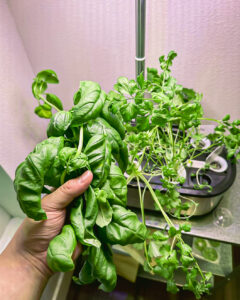
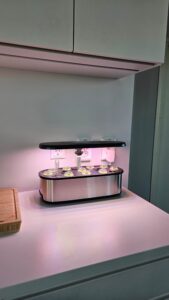
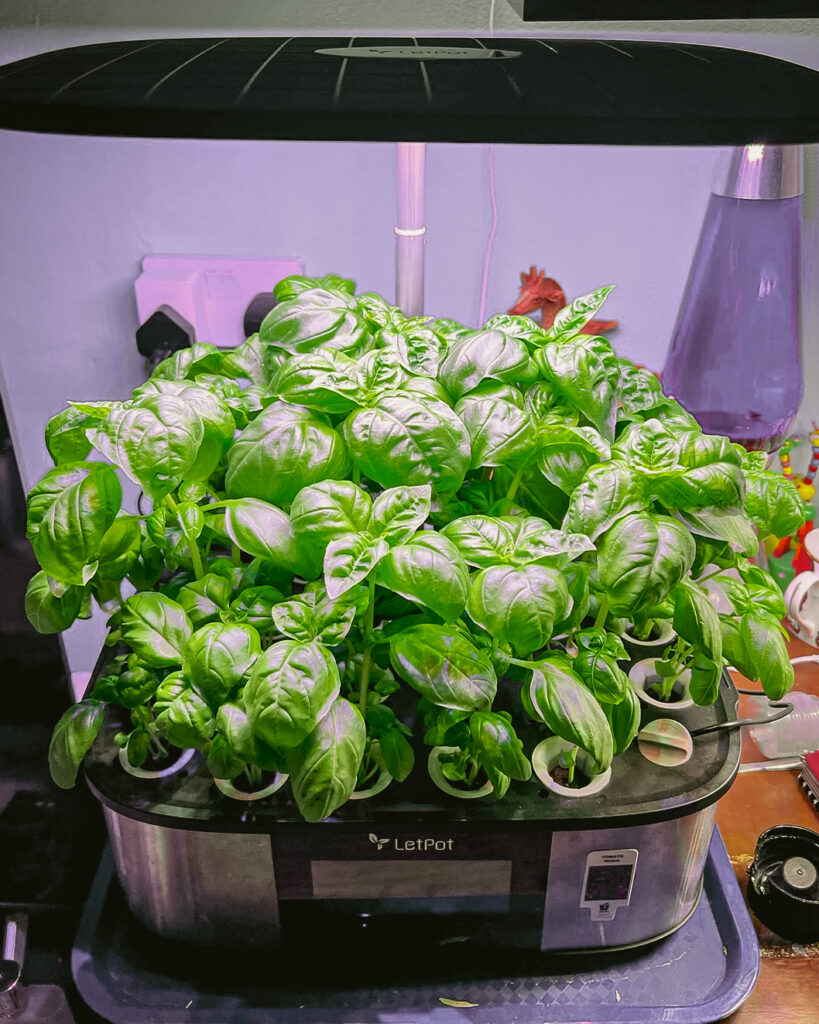
If you want a low-friction start, a complete kit removes most of the variables I had to learn the hard way: light intensity, root temperature, water cadence, and EC. The LetPot Mini herb garden bundle ships with calibrated grow light, reservoir, and basil/parsley/dill seed pods, which is what I now use for the always-on tray on my counter while heritage varieties live under a separate panel.
Harvesting for longevity, not for tonight’s pasta
The harvesting mistake almost everyone makes is to strip the biggest, lowest leaves first because they look ready. That’s exactly backwards. Lower leaves are the plant’s solar panels for the small shaded branches above. Always harvest top-down by pinching the top shoot with its top two leaves, which is the same motion as routine pinching. The plant then redirects to the next two side branches, the canopy gets denser, and your yield compounds. Over a 10-month run, my Genovese plants produce roughly 5–7 g of fresh leaf per week per plant once established — enough for a household pesto night every fortnight from four plants.
Year-round calendar: what changes by season
Indoor basil isn’t actually constant — your environment shifts even if the plant doesn’t move. Here’s how I adjust:
- March–September: Window light supplements grow light; I run lights 12 h at 60% to hit 14 DLI. Photoperiod stays under 14 h to avoid flowering signals.
- October–February: Lights do almost all the work — 14 h at 100% to push 12–14 DLI. Heat mat on continuously, set to 20 °C. Cut feeding to half strength because growth slows.
- Any month: Pinch every Sunday morning. It takes 90 seconds per plant and prevents 90% of bolting events.
FAQ
How long can one basil plant live indoors?
With proper light, weekly pinching, and warm roots, I’ve kept Genovese basil productive for 11 months from a single seedling. Beyond a year, lignification (stems turning woody) reduces yield even with perfect care, so I succession-sow a new tray every 8 months and rotate plants out.
Can I grow basil indoors without a grow light?
Only in summer, only on a south-facing window, and only one or two months at a time before quality drops. From October to March in northern Europe, a grow light isn’t optional — see our winter herb-growing guide for the seasonal math.
My basil flowered already — is it dead?
Not necessarily. Pinch off every flower stem back to the nearest leaf pair, water deeply, and feed at half strength. If you catch it in the first 1–2 days of bud formation, vegetative growth resumes within a week. If the plant is already woody and bottom-bare, restart from seed — you’ll outpace a rescued plant within a month.
Why are my basil leaves small and pale?
Two suspects: not enough light (most common — measure your DLI) or insufficient nitrogen (less common indoors). Move the grow light 5 cm closer and observe for 7 days. If color doesn’t deepen, increase feed strength by 25%.
Is hydroponic basil better than soil basil indoors?
For year-round consistency, yes. Hydroponic systems give you control over root temperature, EC, and watering cadence in a way pots simply don’t, and basil happens to be near the top of the easy-hydroponics list. If you’re curious whether it fits you specifically, our can I grow basil indoors guide walks through the soil-vs-hydro tradeoff, and what herbs can I grow indoors covers which other herbs reward the same setup.
External references: University of Minnesota Extension — Growing basil and RHS — How to grow basil.