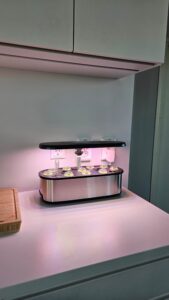
Quick answer: start with basil, leaf lettuce, parsley, dill and chives. These five crops germinate fast in hydroponic pods, tolerate beginner mistakes, recover from over-trimming and reward you with usable harvests in two to four weeks. They are the lineup I planted in my first LetPot Mini, and every single pod made it to the kitchen.
When I unboxed my first LetPot Mini three winters ago, I made every classic rookie move. I overfilled the reservoir, panicked about the light schedule and almost added soil to the pods because I did not trust the water. What saved my first run was the plant list. I had picked five crops that are genuinely hard to fail with indoors, and that single decision turned a wobbly start into a fridge full of fresh herbs by week four. This article is the exact shortlist I would hand to anyone setting up their first smart garden today.
Why these 5 crops never fail in a first-time smart garden
A smart garden does three things automatically: it pumps oxygenated nutrient water past the roots, it runs an LED grow light on a fixed schedule and it reminds you when to refill. What it cannot do is fix a poor crop choice. Some plants need months to mature, others bolt within weeks, and a handful simply do not enjoy hydroponics at all. The five I recommend below share four traits that matter for beginners.
- Germination in 5–10 days at the 22–26 °C that smart gardens hold by default.
- Forgiving of EC swings. They tolerate the 1.2–1.6 mS/cm range most starter kits ship pre-mixed.
- Cut-and-come-again harvest style, so a clumsy first trim does not end the plant.
- Visible progress every 3–4 days, which keeps a new grower checking the unit instead of forgetting it.
According to the Royal Horticultural Society, basil is one of the easiest culinary herbs to raise in a warm, well-lit indoor spot, which is exactly what a smart garden provides. My own log from my first LetPot run shows basil sprouted on day 6, lettuce on day 4, and the slowest of the five (parsley) on day 11. Nothing else even came close to that consistency.
The shortlist at a glance
| Crop | Days to sprout | First harvest | Pods to dedicate | Why it works for beginners |
|---|---|---|---|---|
| Basil (Genovese) | 5–8 | 21–28 days | 2 pods | Loves heat and steady moisture; signals stress early |
| Leaf lettuce | 3–5 | 18–25 days | 2 pods | Fastest visible growth; almost no failure modes |
| Parsley (flat-leaf) | 10–14 | 40–50 days | 1 pod | Slow but unkillable once established |
| Dill | 7–10 | 30–40 days | 1 pod | Tolerates infrequent trimming; aromatic feedback |
| Chives | 7–14 | 35–45 days | 1 pod | Perennial in pods; regrows after every cut |
This plan fills 7 pods. In a 5-pod LetPot Mini, plant one pod of each crop so all five fit. In a 3-pod unit, drop parsley and dill for the first run and double up on basil and lettuce.
Basil — your first must-grow
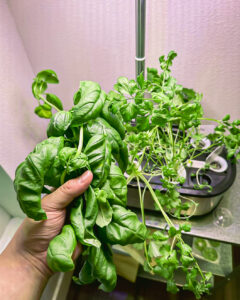
If I could only pick one crop for a first smart garden, it would be Genovese basil seeds. It germinates in under a week, tells you immediately when something is wrong (drooping = water issue, yellowing = light too far away, leggy stems = light cycle too short), and the payoff is a constant supply of leaves for pasta, salads and pesto.
I plant 2 pods with basil because a single pod almost never keeps up with cooking once you start using fresh leaves daily. By week three, each pod produced 8–12 usable leaves per harvest in my LetPot Mini, and I was trimming every five days. The trick I learned the hard way: pinch the top set of leaves the moment the plant hits 15 cm, even if it feels too early. That single pinch doubles the branching and stops the plant from flowering for at least another month.
The University of Minnesota Extension growing-basil guide notes that basil thrives at 21–27 °C with at least 6 hours of strong light, which lines up exactly with a smart garden’s default 16-hour LED cycle. You do not need to adjust a single setting.
Leaf lettuce — fastest visible win
Lettuce is the crop that convinces new growers the system actually works. Loose-leaf varieties like Salanova, Lollo Rossa or basic green oakleaf sprout within 4 days and produce harvestable leaves within three weeks. There is no germination drama, no temperature fuss and almost no pest pressure indoors.
From my first run, I had lettuce on the table by day 22 — well before the basil was ready for serious harvesting. Use lettuce seeds labelled as cut-and-come-again, and never let a head fully mature. Take the outer leaves only, leave the centre intact, and a single pod gives you 6–8 weeks of salads before it bolts.
One detail that is rarely explained well: smart gardens run their LEDs hotter than people expect, which makes lettuce bolt earlier than a windowsill plant. If your unit lets you shorten the light cycle to 14 hours after week three, do it — you will get two extra weeks of clean leaves.
Parsley, dill and chives — three forgiving herbs
These three round out the lineup because they require almost no daily attention but reward you across an entire season.
Parsley
Flat-leaf parsley seeds take 10–14 days to germinate, which feels endless when basil is already 3 cm tall. Do not give up on the pod — parsley is reliable once it gets going. By week 6 you will have steady cuttings that last through 3–4 months of regular use.
Dill
Dill is the most aromatic crop on this list. A single dill seeds pod scents the whole kitchen by week four. Keep trimming the top growth or it will try to flower and stop producing soft leaves. I trim mine every 7 days and the plant just keeps branching.
Chives
Chives seeds germinate slowly (10–14 days) but the pod can last 8 months or longer with regular cuts. They are the only true perennial on this list inside a smart garden, and they survive missed refills better than any other crop I have tested.
If you want to skip the trial-and-error of mixing your own seeds, the LetPot Mini Herb Garden starter bundle ships with all three pre-seeded in organic pods alongside the unit itself.
What to AVOID in your first month
Three plant categories cause more first-month failures than any others, even though they look tempting on packaging photos.
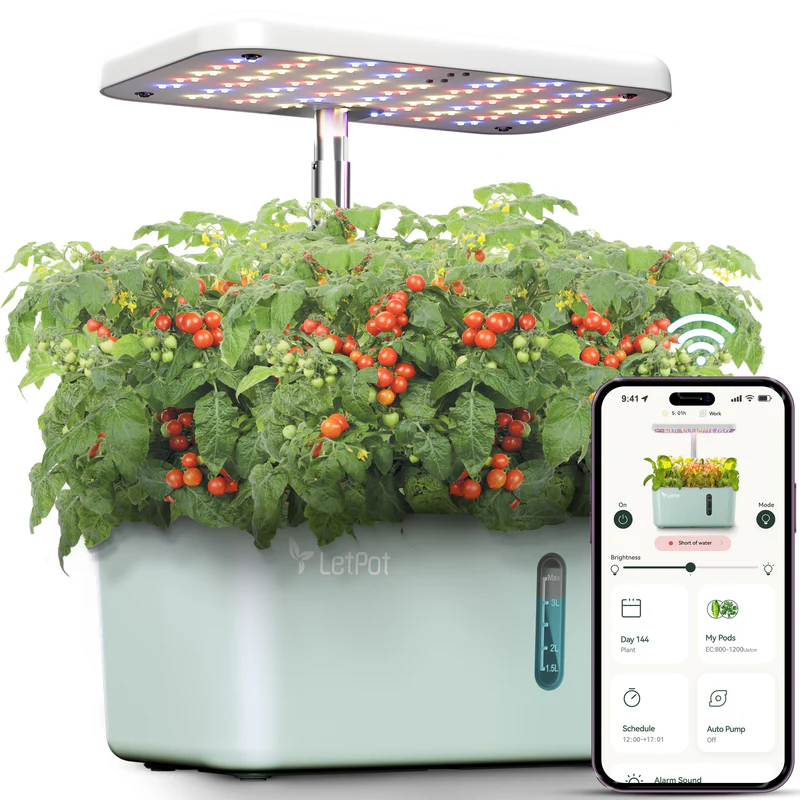
- Tomatoes and chillies. Both need 60–90 days to fruit and grow far taller than a Mini-class unit’s LED head. They are excellent in larger smart gardens — just not in your first 4 weeks.
- Mint. Mint is famously easy to grow, which is the problem. It dominates the reservoir, tangles roots with neighbouring pods and stunts everything else. Run it in a dedicated unit if you must.
- Rosemary and lavender. Both are woody Mediterranean perennials that prefer dry roots and dislike the constantly wet pod environment. Most new growers lose them within 5–6 weeks.
For a deeper look at which crops genuinely thrive indoors, the IndoorGarden post on the easiest and fastest plant to grow indoors walks through the failure modes in more detail.
Frequently asked questions
How many of each plant should I start in a 3-pod unit?
Plant 2 basil pods and 1 lettuce pod. Skip the slower herbs entirely on your first run — you will get visible results in 3 weeks and learn the system without long waits. Move to parsley, dill and chives in your second cycle.
Can I plant all 5 from seed at once?
Yes, and it is the recommended approach in a 5- or 6-pod unit. Smart gardens space out their first harvests naturally because each crop has a different growth speed. By week 7 you will have rolling production across all five.
Do I need to change the nutrient water more often with these crops?
No. The standard 14-day refill cycle that most smart gardens recommend is correct for all five. Top up with plain water between cycles whenever the level drops more than 1 cm below the fill line. For more on hydroponic nutrient timing, see what is a smart garden and how does it benefit home growers.
What if my basil grows leggy and pale?
The LED is either too far from the canopy or running too few hours. Lower the light arm to within 5 cm of the top leaves and confirm the unit is running a 16-hour cycle. Basil that gets less than 14 hours of light indoors will stretch every time.
How long before I should plant a second round?
Start your second seedling tray on day 35–40, in tray germination, then transplant into the unit as the first crops finish. Lettuce is usually the first to bolt, around week 8, and parsley the last to retire, around month 5.
After the first crops — what’s next
Once you have run through one full cycle with these five, you will know your unit’s quirks: how fast it drinks water, how warm it runs, how loud the pump is at night. That is the moment to add complexity. Cherry tomatoes and dwarf chillies become realistic in a Senior- or Max-class unit, and herbs like coriander, thyme and oregano are excellent second-cycle additions. For a wider tour of what is possible indoors, the IndoorGarden guide on what herbs can I grow indoors covers 15 candidates with their indoor difficulty ratings.
Ready to plant your first round? Browse the full range of seeds for indoor gardens and hydroponics — every variety listed is tested in IndoorGarden’s own LetPot units before it goes on sale.