An LED grow light spectrum is the mix of colours a light emits, and plants mainly use the red and blue parts of PAR, the 400 to 700 nm band that powers photosynthesis. PPFD tells you how much usable light reaches the leaf, while kelvin only describes how white the light looks. For most homes, a full-spectrum white LED covers every growth stage.
Grow light marketing is full of numbers designed to confuse you, and I spent my first year indoors buying the wrong lamps because of it. PAR, PPFD, kelvin, lumens, wattage: each one measures something different, and shops lean on whichever sounds most impressive. Once you understand what each term actually describes, the choice gets simple and you stop overpaying for the wrong specification. Here is the plain-language version I wish I had when I started, built on plant science rather than packaging claims.
What spectrum actually means
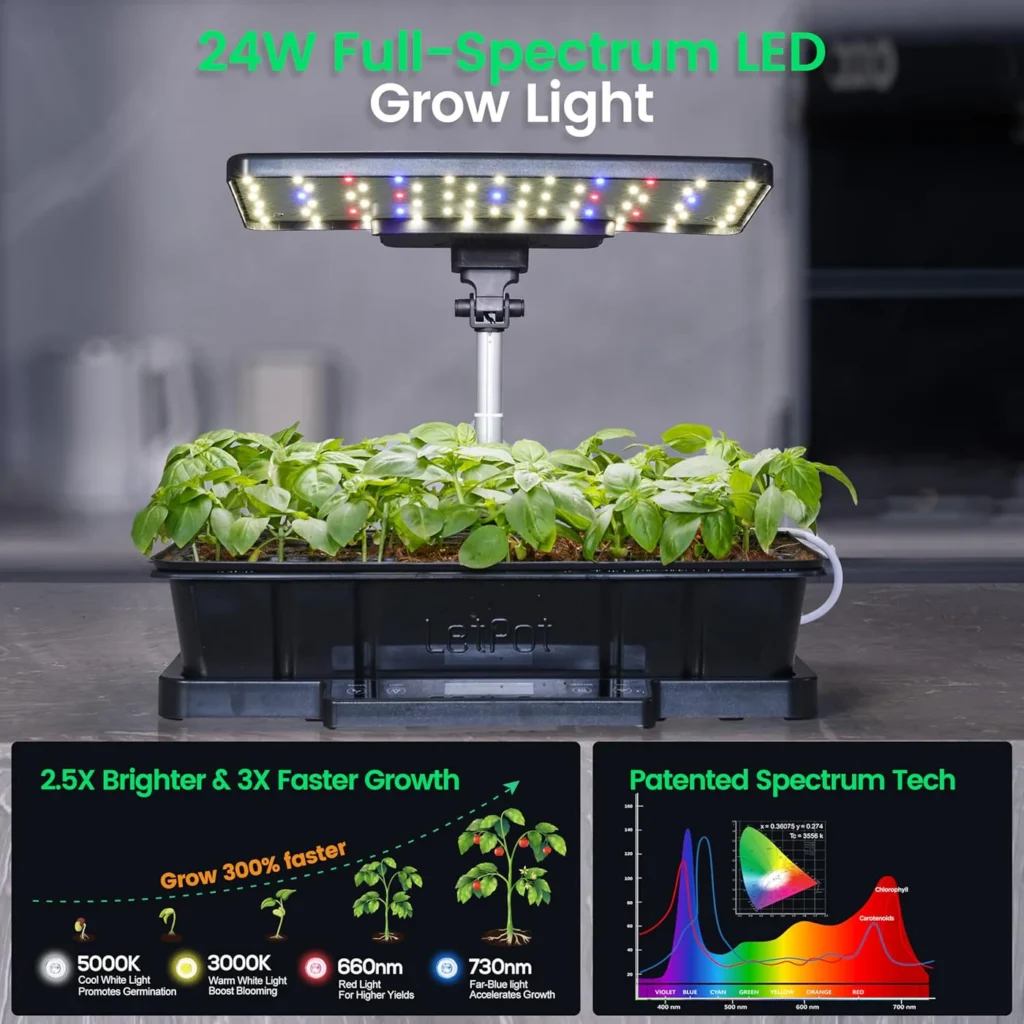
Spectrum is the range of light colours a lamp emits, from violet through blue, green and yellow to red and on into far red. Plants do not use all of it equally. The slice they care about is called Photosynthetically Active Radiation, or PAR, which covers roughly 400 to 700 nanometres, and within that band blue and red light do most of the work. According to the University of Minnesota Extension, PAR is composed primarily of red and blue light, and modern LEDs have become efficient enough that some emit only those two wavelengths. Blue light, around 400 to 500 nm, encourages compact leafy growth and suits seedlings and greens. Red light, around 600 to 700 nm, drives flowering and fruiting and keeps plants from stretching. A lamp that mixes both, or a balanced white that contains both, will grow almost anything.
PAR, PPF and PPFD: the numbers that matter
These three look similar and mean different things. PAR names the useful waveband. PPF, photosynthetic photon flux, measures how much usable light a lamp produces in total each second, counted in micromoles per second. PPFD, photosynthetic photon flux density, measures how much of that light actually lands on a given patch of leaf, counted in micromoles per square metre per second, and it falls quickly as the plant moves further from the lamp. PPFD is the figure that decides whether your plant thrives, because a powerful light held too high still delivers weak intensity at the leaf. The University of Minnesota groups indoor light into low, medium and high bands, which is a useful sanity check when you read a product page.
| Light level | PPFD (µmol/m²/s) | Suits |
|---|---|---|
| Low | 50 to 150 | Foliage houseplants, shade lovers |
| Medium | 150 to 250 | Herbs, leafy greens, seedlings |
| High | 250 to 450 | Fruiting plants, flowering, citrus |
For comparison, leafy crops like lettuce do well around 250 micromoles, while fruiting plants reward you for pushing higher, and most quality home panels sit comfortably in these ranges at a sensible hanging height.
Kelvin and colour temperature, and why it matters less than you think
Kelvin describes how warm or cool a white light looks to the human eye, not how good it is for plants. A low figure near 2700 K looks warm and orange and leans toward the red end, which suits flowering and fruiting, while a high figure near 5000 to 6500 K looks cool and bluish and favours compact vegetative growth. It is a rough proxy for spectrum rather than a precise one, because two lamps with the same kelvin rating can carry very different amounts of usable red and blue. Treat kelvin as a quick hint on a white LED, handy for choosing a warmer or cooler tone, but lean on PAR and PPFD for the decision that matters. And ignore lumens entirely, since that figure measures brightness to your eye and skips the wavelengths plants actually need.
What different plants actually need
Spectrum is only half the story, because intensity, distance and hours all interact. The University of Minnesota’s guidance converts neatly to metric and gives a reliable starting point for the plants people grow on a windowsill.
| Plant stage | Light hours per day | Lamp distance | Spectrum |
|---|---|---|---|
| Seedlings | 16 to 18 | 10 to 15 cm | Blue or balanced white |
| Lettuce and herbs | 12 to 14 | 15 to 30 cm | Balanced white |
| Foliage houseplants | 12 to 14 | 30 to 60 cm | Balanced white |
| Flowering and fruiting | 14 to 16 | 15 to 30 cm | Red-rich or balanced |
Seedlings need long days and a close light to stop them stretching, leafy greens are forgiving, and flowering plants want more red and a slightly longer photoperiod to set buds and fruit. If you want to put real numbers on your own space, my guide to what DLI is and how much light your plants need turns intensity and hours into a single daily figure.
Spectrum myths worth ignoring
A few claims follow grow lights around and deserve to be retired. The first is that plants need a purple light, when that colour is just cheap red and blue diodes, and a white full-spectrum lamp with the same PAR grows equally well while looking far better in a room. The second is that more watts always means more growth, when watts only measure energy drawn rather than usable light delivered, so an efficient lamp can outgrow a thirstier one. The third is that green light is wasted, when in fact plants do use some green, which also penetrates deeper into a leafy canopy than red or blue. Judge a lamp on its PAR output and the intensity it puts on the leaf, and the marketing colours stop mattering.
How to choose a grow light without overthinking it
For almost every home grower, a full-spectrum white LED is the right answer, because it contains the red and blue plants need, looks natural in a kitchen rather than casting a purple glow, and works across every growth stage. Check three things on the label before you buy: that it reports PPF or PPFD rather than only watts or lumens, that it covers the full PAR range or is described as full-spectrum white, and that its coverage area matches your shelf. LEDs win on efficiency, lifespan and low heat, which is why they have largely replaced fluorescent and sodium lamps for indoor growing. You can see the range I stock and use in the grow lights for indoor plants category, and there are free calculators in my indoor gardening tools to size light to plant. For the full walkthrough on fitting and running one, my guide to how grow lights work and how to use them covers setup in detail.
Frequently asked questions
Is full-spectrum better than red and blue?
For home growing, yes in practice. Red-and-blue lights can be marginally more efficient, but full-spectrum white grows every stage, renders plant colours naturally and avoids the harsh purple light that makes a kitchen unpleasant.
What PPFD do I need for herbs and lettuce?
Leafy greens and herbs do well at roughly 150 to 250 micromoles per square metre per second, and lettuce is happy around 250. You reach that by matching a decent panel to the right hanging height rather than buying the most powerful lamp.
Does kelvin tell me if a light is good for plants?
Only loosely. Kelvin describes the white tone your eye sees, so a 2700 K lamp leans red and a 6000 K lamp leans blue, but it does not guarantee usable PAR. Check PPF or a full-spectrum rating instead.
How far should the light sit from my plants?
Seedlings want a lamp 10 to 15 cm away, hydroponic lettuce and herbs 15 to 30 cm, and leafy houseplants 30 to 60 cm. Raise the light as plants grow to keep intensity steady without scorching the leaves.
Can I just use a normal LED bulb?
A standard household LED emits some usable light but is tuned for your eyes, not for plants, so growth is slow and leggy. A purpose-built grow light delivers the red and blue intensity plants need to grow properly.
Putting it together
Once you strip away the jargon, the rule is simple: choose a full-spectrum white LED, check that it reports PPF or PPFD rather than only watts, and set it at the right height and hours for what you are growing. Get those three right and the spectrum looks after itself. When you are ready to pick one, browse the grow lights for indoor plants I trust, and match the panel to your shelf and your plants.