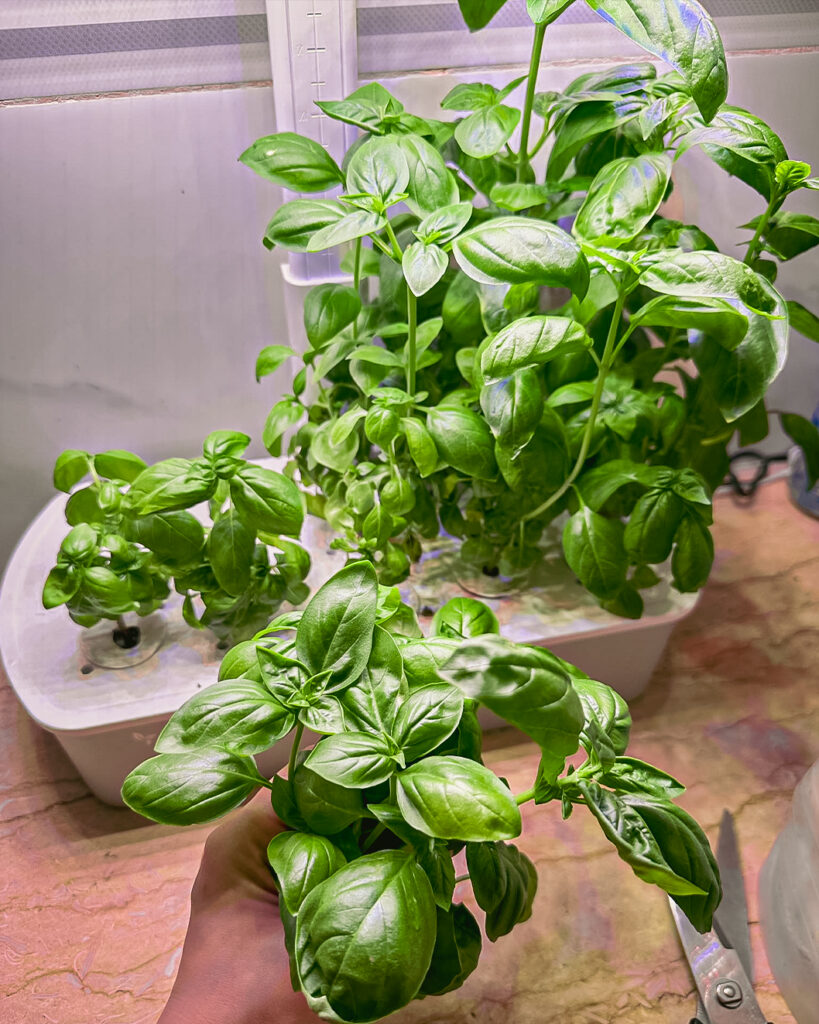
Basil not growing indoors almost always comes down to light rather than water. Basil builds real leaf mass at a daily light integral near 15 mol/m²/day, which means 12 to 16 hours under a grow light. Cold rooms below 15 °C, cramped roots, weak nutrients and unpinched flower buds explain nearly everything else.
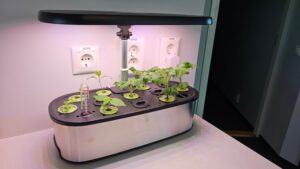
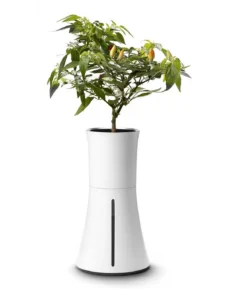
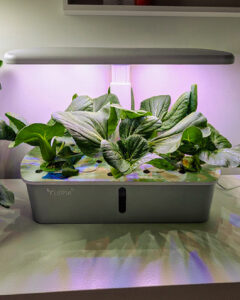
Basil grown in soil pots, in a LetPot Mini or in a Botanium shows the same pattern every winter. The plant is alive, it simply refuses to get bigger. New leaves the size of a fingernail, a stem that stalls at 10 cm, barely any smell when you rub a leaf between your fingers. In almost every case, the fix takes under ten minutes and costs nothing at all.
Cause 1: the light is far weaker than you think
Daily light integral, or DLI, is the total usable light a plant collects over 24 hours, measured in mol/m²/day. It is the single number that predicts basil growth better than any other, and it is the one most people never check. Research at Iowa State University found that raising DLI from 7 to 15 mol/m²/day increased sweet basil fresh mass by 144 percent, with optimal instantaneous intensity around 500 µmol/m²/s. Growth keeps climbing until roughly 29 mol/m²/day.
A north-facing windowsill in Tallinn in December delivers somewhere between 1 and 3 mol/m²/day. That is not a small shortfall, it is a factor of five to fifteen. The plant survives, it just has nothing to build with. Move the pot to the brightest window you own and add a grow light on a timer for 14 to 16 hours a day, positioned 15 to 25 cm above the canopy. If you want to check your own numbers before buying anything, the free indoor gardening tools include a DLI calculator that works from your window direction and month.
The full breakdown of how these figures translate to home setups is in the guide on what DLI means for indoor plants. For the source data, see Produce Grower on temperature and light in basil production.
Cause 2: the room is colder than basil tolerates
Base temperature is the point below which a plant stops developing new leaves entirely. For basil that threshold sits at roughly 8 °C, and leaf unfolding speeds up steadily all the way to about 29 °C. Anything under 15 °C and the plant more or less parks itself.
This catches people out because room air can read a comfortable 21 °C while the glass 3 cm from the leaves sits at 9 °C on a January night. A 10 °C gap between a windowsill pot and the middle of the same room is common. Pull the plant 20 to 30 cm back from cold glass overnight, keep it away from a draughty balcony door, and stop watering with cold tap water straight from the pipe. Room-temperature water alone restarts more stalled basil than any fertiliser.
Cause 3: the roots have run out of room
A root-bound plant is one whose roots have filled the container and begun circling the walls, which caps both water uptake and nutrient access. Supermarket basil is the classic offender because it is sold as 15 to 30 seedlings crammed into one 9 cm pot, grown fast for shelf life rather than longevity.
Slide the plant out and look. If you see a solid white mat of circling roots and almost no growing medium, that is your answer. Split the clump into two or three sections, pot each into a 15 to 18 cm container with drainage holes and at least 2 litres of fresh medium, loosen the circling roots with your fingers, and water once thoroughly. Expect a pause of three to seven days before new tips appear. In a hydroponic system this problem takes a different form: roots choke the net pot and block flow, so trim any brown, slimy roots and check the pump is actually cycling.
Cause 4: feeding is too weak, or too strong
Electrical conductivity, or EC, measures how much dissolved nutrient sits in your water, expressed in mS/cm. Basil is a moderate feeder and runs well between 1.2 and 1.6 mS/cm in hydroponics. Below 0,8 mS/cm growth slows and lower leaves go pale yellow from the bottom up, which is the classic nitrogen signature.
In soil, a plant that has been in the same pot for more than eight weeks has generally exhausted the starter charge in the mix. Feed a balanced liquid fertiliser at half strength every two weeks. In a smart garden, top up nutrients on the schedule the manufacturer prints rather than when you happen to remember. Going the other way is just as damaging, and over-feeding shows up as leaf tips that scorch brown and curl. There is more detail on the numbers in the post on EC in hydroponics.
Cause 5: it flowered, and growth stopped
Bolting is the shift from leaf production to flowering, triggered by stress, age or long days, and it is a one-way switch unless you intervene. Once flower spikes form, basil redirects everything into seed and leaf output collapses. Flavour drops with it, turning sharp and slightly bitter.
Pinch the top of every stem above a pair of leaves as soon as you see buds forming, and keep pinching every 10 to 14 days from the moment the plant has four true leaf pairs. Each pinch forces two new shoots, so a plant pinched five times carries far more harvestable leaf than one left alone. The full method is in how to grow basil indoors year-round without bolting.
Cause 6: fusarium wilt or root rot
Fusarium wilt is a soil and seed-borne fungal disease caused by Fusarium oxysporum f. sp. basilicum, and it targets sweet basil specifically. According to University of Maryland Extension, infected plants grow normally until they reach roughly 20 to 30 cm, then become stunted and wilt, with brown streaks on the lower stem and yellow, malformed leaves. Spores can persist in soil for 8 to 12 years.
There is no home cure. Discard the plant and its growing medium, sterilise the pot, and start again from certified clean seed. Root rot from overwatering looks similar from above but gives itself away below the surface with brown, soft, sour-smelling roots. Sound seed is the cheapest insurance here, which is why only reliable stock such as Sweet Basil Italiano Classico is worth sowing.
Match the symptom to the cause
| What you see | Most likely cause | Fix | Time to visible change |
|---|---|---|---|
| Long bare stems, small pale leaves | Too little light | Grow light, 14 to 16 h/day at 15 to 25 cm | 7 to 10 days |
| Plant simply frozen in size, leaves normal colour | Room below 15 °C | Move back from glass, warm the water | 5 to 14 days |
| Yellowing from the bottom up | Nitrogen shortage or exhausted medium | Half-strength feed every 2 weeks | 10 to 14 days |
| Wilts hours after watering | Root-bound or root rot | Divide and repot, or discard if roots are brown | 3 to 7 days |
| Flower spikes, bitter flavour | Bolting | Pinch above a leaf pair, repeat fortnightly | 7 to 14 days |
| Brown stem streaks at 20 to 30 cm tall | Fusarium wilt | Discard plant and medium, resow clean seed | No recovery |
The ten-minute diagnostic worth running
- Touch the leaves nearest the window at night. If they feel cold, temperature is your problem.
- Count the hours of usable light. Under 12, light is your problem.
- Lift the pot out of its cover. No drainage hole means chronic wet feet.
- Slide the root ball out. Solid white circling roots means it is root-bound.
- Check the lowest leaves. Even yellowing from the base upward points to feeding.
- Look for buds. Any flower spike means pinch now.
- Scrape the stem base with a thumbnail. Brown streaking under the skin means disease.
Frequently asked questions
How long should basil take to grow indoors?
From sowing, expect germination in 5 to 10 days at 20 to 25 °C, a first small harvest at 4 to 6 weeks, and a full bushy plant at 8 to 10 weeks. In a hydroponic smart garden with 16 hours of light, first harvest is typically around day 25.
Why is my basil growing so slowly in winter?
Shorter days and colder glass hit both drivers at once. Natural DLI in northern Europe drops below 3 mol/m²/day in December, and windowsill temperatures fall towards the 8 °C threshold overnight. A timer-controlled grow light running 16 hours fixes most of it.
Should I cut off the yellow leaves?
Yes, once you have identified and fixed the cause. Yellow leaves do not turn green again, and removing them lets the plant put its resources into new growth. Take no more than a third of the foliage in one go.
Does supermarket basil ever recover?
Often, but only after division. Those pots hold 15 to 30 seedlings competing for the same 9 cm of medium. Split the clump into two or three, repot into 15 cm containers, and treat each as a separate plant.
Can basil grow without any direct sunlight?
Yes, under artificial light alone. A full-spectrum LED delivering 200 to 300 µmol/m²/s over 16 hours puts you near 12 to 17 mol/m²/day, which is comfortably in productive territory. Sunlight is convenient rather than essential.
How often should I water basil indoors?
Water when the top 2 cm of medium feels dry, which in a heated room usually means every 2 to 3 days. Basil wants consistently moist medium and hates standing water. If the plant is stalled and the room is dim, it will drink far less, so check before you pour.
Where to start if your basil has stalled
Work through the diagnostic in order and fix one thing at a time, because changing light, feed and pot together leaves you with no idea what worked. Light and temperature account for roughly four out of five stalled plants, and both cost nothing to test. If the plant turns out to be diseased or hopelessly root-bound, starting fresh from good seed is faster than nursing it. You can browse suitable varieties in the herb seeds range at IndoorGarden.