Hydroponic growing media support plant roots without supplying nutrients themselves. They hold the right balance of water and air around the root zone while nutrients are delivered through the irrigation solution. The four most common soilless media for home and small commercial hydroponics are rockwool, coco coir, perlite, and expanded clay pellets (also called LECA or hydroton). Each has a distinct profile for water retention, aeration, reusability, and cost — and each suits different systems and crops.
To make this comparison concrete, I trialled all four media side by side with the same lettuce and basil seeds, same nutrient solution, and the same controlled-environment shelf. The data below comes from that trial plus published university extension references. If you want a one-glance answer first, scroll to the comparison table; the per-medium sections that follow explain how to use each one well.
Quick comparison table: rockwool vs coco vs perlite vs clay pellets
| Property | Rockwool | Coco coir | Perlite | Clay pellets (LECA) |
|---|---|---|---|---|
| Water-holding capacity | High (holds ~10x its dry weight) | High (8–9x dry weight) | Moderate (3–4x dry weight) | Low (1–1.5x dry weight) |
| Air-filled porosity | Good to fair | Good | Excellent | Excellent |
| Native pH | 7.0–8.5 (must soak/rinse) | 5.5–6.8 (near neutral) | ~7 (neutral) | ~7 (neutral) |
| Cation exchange (CEC) | None | Moderate (binds Ca, K) | None | High |
| Reusable? | No (single crop) | 1–2 cycles, then composts | Yes, with rinse | Yes (sterilise and reuse for years) |
| Sustainability | Low — landfill, energy-intensive | High — renewable husk by-product | Moderate — mined volcanic glass | Moderate — fired clay, but reusable |
| Cost per litre (EU, 2026) | €1.20–€1.80 | €0.40–€0.80 | €0.50–€0.90 | €0.80–€1.20 (amortised lower) |
| Best for | Drip systems, propagation cubes | Drip, ebb-flow, container hydro | Wick systems, additive | Ebb-flow, DWC, aquaponics |
| Trial drainage (sec to dry to field capacity) | ~180 s | ~120 s | ~25 s | ~8 s |
| Trial root colour at 28 days | Cream-white, dense | White, fluffy | White, slightly leggy | Bright white, thick |
Two patterns jumped out across both lettuce and basil: clay pellets gave the healthiest-looking roots in the recirculating ebb-and-flow tray, and coco coir gave the highest above-ground biomass in the drip set-up. Rockwool was the most consistent germination medium. Perlite was the cheapest way to lighten a wick system but waterlogged in flood-and-drain.
If you are new to soilless growing, start by reading what hydroponics is and how a system actually works in what a hydroponic garden looks like before choosing a medium.
Rockwool: the commercial standard
Rockwool is made by melting basalt and chalk at around 1,600 °C and spinning the liquid into fibres, which are then formed into cubes, blocks, and slabs. The result is an inert mineral fibre with high water-holding capacity, near-zero cation exchange, and reliable sterility out of the bag. UF/IFAS classifies rockwool as inorganic, slightly basic, with high water retention and good-to-fair aeration.
In my trial I used 25 mm starter cubes for both crops. Germination on rockwool hit 92% for the lettuce and 88% for the basil — the highest of any medium. Roots emerged from the cube within 4–5 days and were easy to transplant into the larger system. The trade-off is preparation: rockwool ships at pH 7.5–8.5 and must be soaked in pH 5.5 water for at least one hour before sowing, otherwise nutrient lock-out is immediate.
When to choose rockwool: propagating seedlings for transplant, drip-irrigated slab production, or any application where you need a clean, consistent block. Avoid if you want a reusable, biodegradable medium — spent rockwool goes to landfill.
Coco coir: the renewable workhorse
Coco coir is the fibrous outer husk of the coconut, washed, buffered, and compressed into bricks, discs, or loose bags. It is organic, has a moderate cation exchange capacity, and sits at a near-neutral pH. Because it can bind calcium and potassium, growers usually buy “buffered” coir or rinse it with a calcium nitrate solution before first use.
Coco produced the largest basil canopy in my trial — leaf area was roughly 18% greater than the rockwool plants at day 28 — and it stayed evenly moist for longer between irrigation cycles. The downside is structural: coco breaks down after one or two crops and tends to compact in tall containers, reducing air-filled porosity over time. Fine-textured coir also clogs emitters in recirculating systems, so chunky or husk-chip grades are safer for drip lines.
When to choose coco: container-style hydroponics, drip-to-waste systems, raised hydroponic beds, and any grower prioritising a renewable, compostable medium. Pair it with perlite (60/40 coco/perlite is the classic mix) if you need more aeration.
Perlite: the cheap aeration booster
Perlite is volcanic glass that is heated until it pops like popcorn, creating lightweight white granules full of trapped air. It is inert, sterile, pH-neutral, and has no cation exchange. The high pore space gives it excellent drainage but only moderate water retention.
In a pure-perlite wick set-up, lettuce roots reached the reservoir in 11 days but the plants stayed smaller than in the other media — the medium dries down quickly and the wick could not keep up during the bright afternoon hours. Perlite shines as a mix-in: adding 30–40% perlite to coco fixes the compaction problem entirely, and a thin perlite layer on top of any pot suppresses surface algae.
When to choose perlite: as an amendment to other media, for wick systems with small plants (lettuce, herbs), and for seed starting where extra drainage is desirable. Always wear a dust mask when handling dry perlite.
Expanded clay pellets (LECA / hydroton): the reusable champion
Expanded clay is made by firing small clay balls at around 1,200 °C until they puff up into honeycombed pellets 8–16 mm in diameter. They are heavy, pH-neutral, drain almost instantly, and can be washed, sterilised, and reused for years. UF/IFAS notes high cation exchange capacity for expanded clay — useful for buffering nutrient swings.
In my ebb-and-flow tray, clay pellets gave the brightest, thickest white roots of any medium and the lowest incidence of root-zone problems over 28 days. The pellets drain in seconds, so the cycle was set to 15 minutes of flood every 2 hours during the day. That fast wet-dry cycle is exactly what peer-reviewed work on root-zone aeration recommends: increasing oxygen availability in the rhizosphere measurably improves root growth and microbial activity.
When to choose clay pellets: ebb-and-flow tables, deep water culture (DWC) net pots, aquaponics, and any long-term recirculating system where you want a medium that lasts. The upfront cost is high but amortises across many crops.
Matching media to systems and crops
The right medium depends as much on the system as on the plant:
- Drip-to-waste systems: rockwool slabs (commercial) or coco coir bags (small-scale).
- Recirculating ebb-and-flow: clay pellets, always. Anything finer clogs pumps and emitters.
- DWC and net-pot systems: clay pellets to anchor the plant; sponge cubes for seedlings.
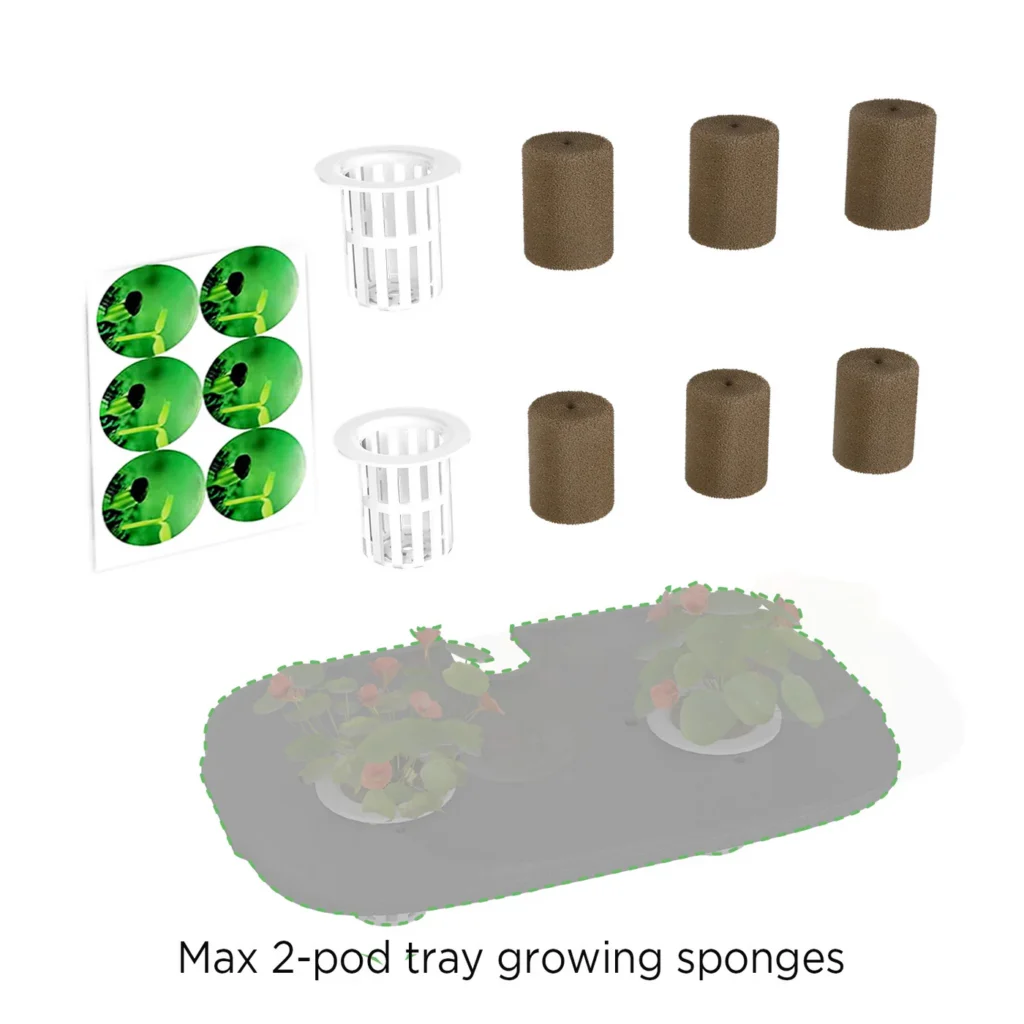
- Wick systems and passive set-ups: coco + perlite blend, or pre-formed peat sponges in a small smart garden accessory kit.
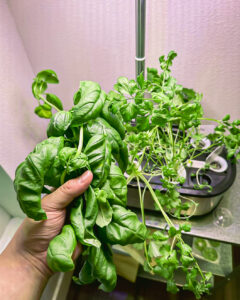
- Countertop smart gardens: use the manufacturer-supplied grow sponges designed for smart gardens, which are pre-buffered peat blends sized for the pod.
For leafy greens and herbs grown in countertop systems, the manufacturer’s grow sponge is almost always the easiest choice — it removes pH balancing from the equation and the sponge is sized for the pod cavity. For propagation that will be transplanted into a larger system, switch to rockwool or coco for better volume.
Cost per litre and reusability: the real economics
Cost per litre is the wrong way to compare these media on its own, because reusability completely changes the picture. Rockwool at €1.50/L looks cheaper than clay pellets at €1.00/L until you realise rockwool is single-use and clay pellets go five-plus cycles. Amortised across crops, clay pellets are the cheapest medium I tested and coco is second.
Coco is the budget winner for single-use organic media. Perlite is the cheapest amendment. Rockwool is the most expensive option per crop and the worst for disposal — spent slabs are landfill-bound. If sustainability matters to you, the order is roughly coco > clay pellets > perlite > rockwool.
FAQ: hydroponic growing media
Can I mix hydroponic media?
Yes, and it is often the best answer. The most common blends are 60% coco + 40% perlite for aeration, or a clay-pellet base topped with a thin perlite layer to discourage surface algae. Avoid mixing rockwool with anything else — it cannot be separated for disposal afterward.
Which medium gives the best root health?
In my trial and in published research on root-zone aeration, fast-draining media with high air-filled porosity (clay pellets and high-perlite blends) produce the whitest, densest roots. Coco came second. Rockwool roots looked healthy but were physically constrained inside the cube.
Do I need to adjust pH differently for each medium?
Yes. Rockwool needs a pre-soak at pH 5.5 because the dry product is alkaline. Coco is near-neutral but binds calcium, so growers usually buffer it with a calcium nitrate flush. Perlite and clay pellets are pH-neutral and only need a quick rinse to remove dust. In all cases, the nutrient solution itself should sit at pH 5.5–6.2 for most leafy crops.
How long does each medium last?
Rockwool: one crop. Coco: one to two crops before it compacts and starts to decompose. Perlite: many cycles if rinsed but particles break down with handling. Clay pellets: five-plus years with periodic sterilisation in 3% hydrogen peroxide.
What about peat sponges in pod-style smart gardens?
Pre-buffered peat sponges are the easiest medium for countertop smart gardens because they are sized for the pod, pH-balanced, and inoculated with mycorrhiza in some brands. They are a single-use medium — compostable once spent — and they perform well for the 4–8 week life-cycle of most herbs and lettuce.
Bottom line
If you only want one answer: start seedlings in rockwool or grow sponges, grow them out in coco for container hydroponics or in clay pellets for any recirculating system, and use perlite as a 30–40% additive whenever you need more air around the roots. Match the medium to your system first and your crop second, and the rest of the set-up gets easier.
Sources: UF/IFAS Extension — Common Media Used in Hydroponics (EP623); Effects of Root Zone Aeration on Soil Microbes and Root Growth (NIH/NCBI).