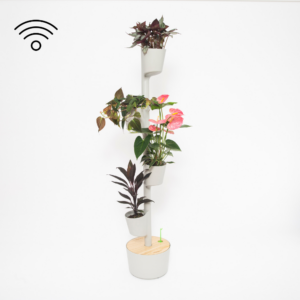
Gardyn’s Home 4 grows up to 30 plants in a tall vertical tower, but it is a US-only product that does not officially ship to the EU, and its $899 list price does not include any import duty or the plug conversion a 120 V unit needs here. CitySens vertical planters (3 or 4 pots, from €189) and the 21+2-pod LetPot Max (€249) are the closest systems IndoorGarden actually stocks, each shipped from Tallinn with a 2-year EU warranty.
Gardyn has built a loyal following in the US for its tall, camera-equipped tower, and plenty of European growers find it through a review video only to discover there is no EU store, no local warranty, and a plug built for a different mains supply. This guide compares the systems IndoorGarden actually stocks that answer the same brief — tall, vertical or high-capacity growing — against what Gardyn itself offers, so you can see what a European buyer gets instead of an import.
Products mentioned — in stock at IndoorGarden, shipped from Tallinn across the EU.
Why Gardyn is hard to buy in Europe
Gardyn sells the Home 4 directly through its own US store, and Bob Vila’s review of the current model lists it at $899, growing up to 30 plants in a roughly 61 × 30 × 163 cm tower that takes about 0.2 m² of floor space. Neither that review nor Gardyn’s own product page mentions an EU store, EU pricing or international shipping, and the unit’s power and Wi-Fi specifications are written for a US household rather than a European one. Buying one from outside the US means paying for shipping across the Atlantic, clearing EU import duty and VAT on top of the list price, and sorting out a plug and voltage conversion yourself, since nothing in the box is built for a European socket.
There is also a running cost Gardyn adds that none of the systems below carry: an optional but heavily promoted membership, which runs from $29 to $39 a month after a 30-day trial and unlocks the app’s growth-tracking and reordering features. None of that makes Gardyn a poor product in its home market. It just means a European buyer comparing it against what actually ships here is comparing a US import against three systems already sitting in an EU warehouse.
CitySens vertical planters: the closest shape match
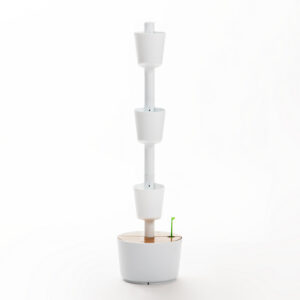
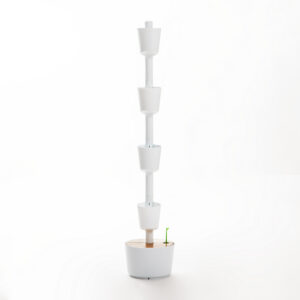
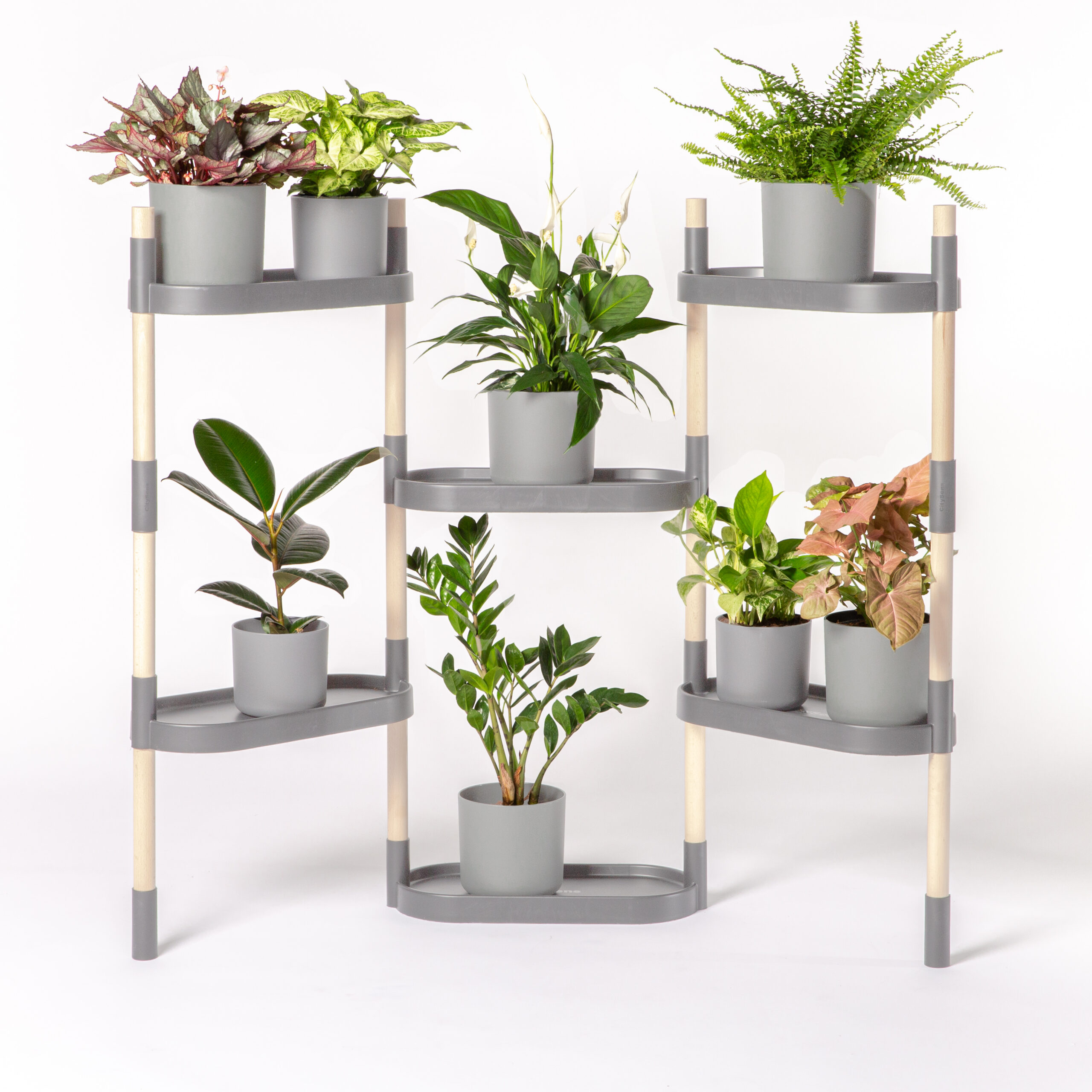
CitySens is a Barcelona-based brand that builds its vertical planters around the same idea Gardyn uses: pots stacked upward on a single column rather than spread across a counter. The 3-pot CitySens stands 115 cm tall on a 29 cm base and holds three 13 cm pots, while the 4-pot version adds one more tier to reach 148 cm. Both use a Wi-Fi timer that schedules up to 16 watering cycles a week and run on roughly €0.20 of electricity a year, since the pump only needs to lift water to the top pot once and gravity carries it down through the rest.
The watering method is the detail that separates CitySens from a simple reservoir system: water is pumped to the top pot, drains down pot by pot, and the surplus collects back in the base to be reused on the next cycle, which the manufacturer says saves up to half the water and nutrients a hand-watered column would use. That design gives a stated autonomy of 30 days in summer and up to 60 in winter, so topping up the reservoir is closer to a monthly job than a weekly one. Each unit ships with two years of plant nutrients and carries a 2-year warranty against manufacturing defects.
LetPot Max: more plants, a different footprint
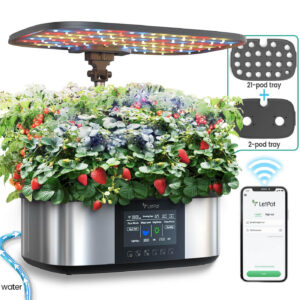
If what drew you to Gardyn was plant count and automation rather than the vertical shape itself, the LetPot Max is the closer match on capacity. It runs 21 standard pods plus 2 larger ones in a wide countertop tray rather than a floor-standing tower, with a 7.5 L reservoir, a 36 W full-spectrum LED, and a light arm that extends up to 76 cm, tall enough for a dwarf tomato or chilli plant rather than herbs alone. A touchscreen on the unit handles day-to-day settings without the app, though Wi-Fi and app control are there if you want remote monitoring.
The trade-off against a CitySens tower is shape rather than capability: the Max needs a wider stretch of counter instead of a narrow vertical footprint, so it suits a kitchen with floor space to spare more than one that only has a bare wall free. Like the rest of the range we carry, it ships from our Tallinn warehouse with a 2-year EU warranty and uses open hydroponic pods, so any seed works rather than a locked proprietary cube.
Which one fits your space and budget
A narrow hallway or a bare wall with no counter to spare points toward a CitySens planter, since the whole system is a single 29 cm-wide column rather than a wide tray. Three pots at €189 suits someone testing the idea with a few herbs or a trailing strawberry plant, while the four-pot version at €199 adds one more tier for not much extra cost if you already know you want the larger harvest. A kitchen with a free stretch of counter but no spare wall is better served by the LetPot Max, which trades vertical height for 21 pods running at once and enough light clearance to carry a fruiting plant through to harvest. Either route lands well under what a Gardyn import would cost once shipping, duty and a voltage adapter are added to its $899 list price.

Gardyn, CitySens and LetPot Max at a glance
| System | Capacity | Height | Price | Ships to the EU |
|---|---|---|---|---|
| Gardyn Home 4 | Up to 30 plants | ~163 cm | ~$899 (US list price) | No official EU store |
| CitySens, 3 pots | 3 pots | 115 cm | €189.00 | Yes, from Tallinn |
| CitySens, 4 pots | 4 pots | 148 cm | €199.00 | Yes, from Tallinn |
| LetPot Max | 21 + 2 pods | Up to 76 cm | €249.00 | Yes, from Tallinn |
Frequently asked questions
Does Gardyn ship to Europe at all?
Gardyn sells through its own US store and Bob Vila’s review of the current model gives no sign of an EU store or EU pricing. A European buyer is generally looking at a private import, which adds shipping, duty and VAT on top of the US price.
Which alternative looks most like Gardyn?
The CitySens vertical planters are the closest match in shape, since both stack pots upward on a single column rather than spreading them across a counter, though CitySens holds far fewer plants than Gardyn’s 30-plant tower.
Is the LetPot Max as automated as Gardyn?
It covers the same ground on light and watering automation, running its LED and pump on a fixed schedule with app and touchscreen control, though it does not include Gardyn’s camera monitoring or AI plant-health feature.
Do the CitySens planters need Wi-Fi to work?
Wi-Fi is needed to set and change the watering schedule through the app, but once a schedule is set the timer keeps running it on its own, so a temporary Wi-Fi outage does not stop the plants being watered.
Which system is cheapest to run day to day?
CitySens is the lowest-cost to run, at roughly €0.20 a year in electricity thanks to its single top-of-column pump. Gardyn adds an optional membership of $29 to $39 a month on top of its own running costs, which neither CitySens nor LetPot charges.
Can I grow vegetables as well as herbs in a CitySens planter?
Yes, within reason. Trailing and compact plants such as strawberries and lettuce do well in the stacked pots, but a tall fruiting plant like a tomato or chilli needs the LetPot Max’s wider pods and taller light clearance instead.
Where to start
If a bare wall is what you actually have free, start with the CitySens 3-pot vertical planter and add the 4-pot version later if the first one earns its place. If counter space is less of a constraint than plant count, browse the full smart gardens range before deciding between the Max and a smaller LetPot model. Every system here ships from our Tallinn warehouse across the EU, with a 2-year warranty regardless of which one you choose.