Quick answer: The five common hydroponic system types are deep water culture (DWC), nutrient film technique (NFT), the Kratky method, ebb and flow (flood and drain), and aeroponics. DWC and Kratky are the simplest and cheapest for beginners; NFT and ebb and flow scale well for leafy greens; aeroponics gives the fastest growth but needs the most maintenance. For a kitchen counter, a small DWC unit like a smart garden is the easiest entry point.
I have been running hydroponic gear in my apartment for over five years, and I have personally built or used every one of the five systems in this guide. My first build was a Kratky lettuce jar on a windowsill in 2019. Since then I have rotated through a homemade DWC tote for basil, a NFT channel for strawberries on a balcony, an ebb-and-flow tray for chilli seedlings, and an aeroponic cloner for tomato cuttings. This pillar is my own field notes on what works, what breaks, and what to buy if you are just starting out.
What is hydroponics, in one paragraph
Hydroponics is growing plants without soil, feeding the roots a water-based nutrient solution instead. The University of Minnesota Extension defines it as a soilless production method in which a nutrient solution delivers everything the plant needs (UMN Extension). Plants spend less energy hunting for nutrients, so they grow faster — typically 30 to 50 percent quicker than soil for leafy greens, in my own measurements. The differences between the five system types are about how the water-and-nutrient mix is delivered to the roots: still water, thin film, periodic flood, or fine mist. Each method has its own cost, complexity, crop fit, and maintenance load. If you want the wider primer first, see what is hydroponics.
DWC — Deep Water Culture
Deep water culture suspends plant roots directly in an oxygenated reservoir of nutrient solution. A small air pump and air stone (typically 3 to 5 watts) keep the dissolved oxygen above 5 ppm so roots do not suffocate. Penn State Extension lists deep-water float systems as one of the two foundational water-culture techniques (Penn State Extension).
Setup time: 30 to 45 minutes for a single 5-gallon bucket build.
Cost: 25 to 60 euros for a DIY tote; 70 to 250 euros for a finished smart garden.
Best crops: Lettuce, basil, chard, kale, pak choi, mint, strawberries.
Skill level: Beginner.
How it works: Net pots holding rockwool, grow sponges or clay pebbles sit in holes cut into a lid. Roots dangle into the solution below. The air stone breaks the water surface and pushes oxygen down through the root zone. EC is usually held between 1.2 and 1.8 mS/cm for greens, pH between 5.8 and 6.2. I top up the reservoir every 5 to 7 days with a basil-heavy build, and do a full flush every 2 to 3 weeks to prevent salt build-up.
What I like: DWC is forgiving. If the power dies overnight the roots stay wet — they just lose oxygen, which gives you maybe 12 hours before damage. My basil DWC tote produced 110 grams of harvest a week through a Tallinn winter, with zero pest issues. The reservoir buffers temperature swings, so the root zone stays stable.
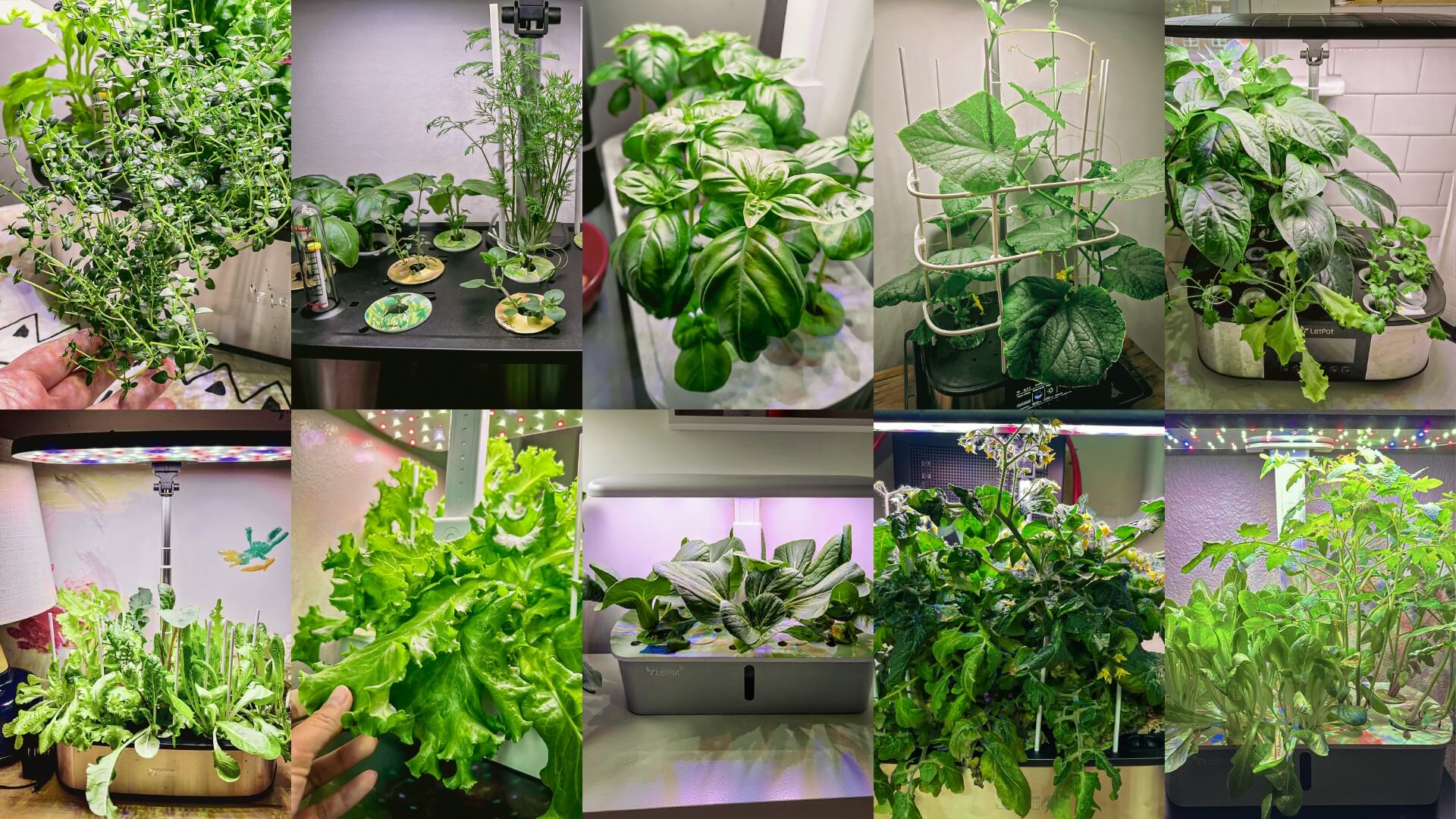
What goes wrong: Root rot from warm water above 24 C is the number-one failure. Add a small chiller, or switch to a darker reservoir in summer. A bigger reservoir (10 L+) makes DWC almost foolproof for a first-time grower. Most consumer smart garden systems sold today are essentially a small DWC unit with a built-in light and timer, which is why they are so beginner-friendly.
NFT — Nutrient Film Technique
NFT runs a thin film (1 to 3 mm deep) of nutrient solution continuously through sloped channels. Roots grow along the bottom of the channel, half-submerged in the film, half exposed to air. Cornell University’s CEA program lists NFT as one of the three main hydroponic methods used in commercial leafy-green production (Cornell CEA).
Setup time: 2 to 4 hours for an 8-channel DIY rig.
Cost: 80 to 200 euros DIY; 400 to 1,500 euros for a commercial NFT kit.
Best crops: Lettuce, herbs (basil, parsley, chives), strawberries, baby spinach.
Skill level: Intermediate.
How it works: A submersible pump (typically 10 to 30 W) lifts solution from a reservoir to the top of a tilted channel (1 to 2 percent slope). Gravity pulls the film back down through net pots, and the solution returns to the reservoir to recirculate. Because the film is shallow, roots get excellent oxygen contact — usually 8 to 10 ppm dissolved oxygen, which is why NFT plants grow so fast.
What I like: Density. I fit 30 lettuce heads in a one-meter-wide NFT bench on my balcony, with a tiny 8 L reservoir. Water use was around 1.2 L per head over a 35-day cycle, easily 10x less than soil. Harvest staggering is simple — just put new plants in the upstream end.
What goes wrong: NFT has zero tolerance for pump failures. If the pump stops, roots dry out within 90 minutes in warm air. Roots can also grow into a mat that blocks the channel and floods it. I now use a backup battery and check root growth weekly. NFT is not suited to fruiting crops like tomatoes — the root mass gets too heavy for the channel.
Kratky method
The Kratky method is passive hydroponics — no pump, no air stone, no electricity. Developed by Bernard Kratky at the University of Hawaii, it relies on the air gap that forms naturally as plants drink down the water level. Roots that stay submerged absorb water and nutrients; roots that grow into the expanding air gap absorb oxygen.
Setup time: 10 to 20 minutes per jar.
Cost: 3 to 15 euros per jar (mason jar, net cup, sponge, nutrients).
Best crops: Lettuce, mizuna, arugula, basil, mustard greens — single-harvest leafy crops.
Skill level: Total beginner.
How it works: You start with the water level just touching the bottom of the net pot. As the plant drinks, the level drops. By harvest, two-thirds of the roots are in air and one-third in water. The whole cycle is calibrated so the water never runs out before harvest. For a head of lettuce that is about 25 to 30 days in a 1 L jar.
What I like: Zero electricity. I keep three jars on my kitchen windowsill year-round and just refill them between harvests. The setup cost was under 20 euros total. Kids love it — my niece grew a lettuce head in a coffee jar with zero adult help.
What goes wrong: Algae if the jar is clear (wrap it in foil). It also fails for long-cycle or large crops — tomatoes, cucumbers, peppers all suck reservoirs dry well before fruit set. Kratky is one harvest, one jar. After that, dump and restart. There is more on this in my hydroponic garden overview.
Ebb and flow (flood and drain)
Ebb and flow floods a grow tray with nutrient solution on a timer (typically every 2 to 4 hours, for 10 to 15 minutes), then drains it back to the reservoir. The cycle gives roots alternating water-and-oxygen exposure. The USDA includes ebb-and-flow benches under its umbrella of innovative controlled-environment production methods (USDA).
Setup time: 2 to 5 hours for a flood-tray rig.
Cost: 60 to 180 euros DIY; 250 to 800 euros for a commercial kit.
Best crops: Chillies, tomatoes, strawberries, herb seedlings, larger leafy greens, peppers.
Skill level: Intermediate.
How it works: Plants sit in pots filled with an inert medium — clay pebbles, coco coir or rockwool. A timed pump fills the tray; an overflow standpipe sets the maximum water height (usually 2 to 3 cm below the medium surface). When the pump shuts off, gravity drains everything back. The medium holds enough residual moisture to last 2 to 4 hours between cycles.
What I like: Ebb and flow handles fruiting crops well. My ebb-and-flow tray with 12 chilli plants produced 3.5 kg of jalapeños over a six-month run — more than DWC ever managed for the same plants. The medium gives roots structural support, which matters once a tomato or pepper plant gets top-heavy.
What goes wrong: Salt build-up in the medium is the long-term issue. I flush with plain water once a month. Pumps stuck on (a failed timer) can flood the floor, so a tray with an overflow drain is critical. Clay pebbles also need rinsing before first use to remove dust that clogs pump intakes.
Aeroponics
Aeroponics suspends roots in air and mists them with nutrient solution every 3 to 5 minutes. Roots get maximum oxygen exposure — usually 10+ ppm dissolved oxygen at the root surface — which is why aeroponic plants typically grow 20 to 40 percent faster than DWC, in my measurements on basil cuttings. Cornell’s CEA program lists aeroponics alongside DWC and NFT as one of the three core soilless methods (Cornell CEA).
Setup time: 3 to 6 hours for a low-pressure DIY build; 1 to 2 days for a high-pressure rig.
Cost: 100 to 300 euros DIY low-pressure; 500 to 2,000 euros high-pressure.
Best crops: Lettuce, herbs, strawberries, microgreens, and propagating cuttings of any species.
Skill level: Advanced.
How it works: Low-pressure aeroponics (LPA) uses standard 0.5 to 1 mm sprayers fed by a 40 W pump. High-pressure aeroponics (HPA) uses 80 to 100 micron mist heads at 60 to 100 psi for ultra-fine droplets. The plant sits in a collar at the top of a chamber; roots hang into the misted void. There is no medium and minimal water — HPA uses around 0.1 L per plant per day for greens.
What I like: Speed and cloning. I propagated 24 tomato cuttings in an LPA aerocloner with a 92 percent strike rate at 8 days — compared to 60 percent in soil at 14 days. For greens, harvests come 5 to 7 days sooner than DWC. The lack of medium also means zero salt build-up in the root zone.
What goes wrong: Clogged nozzles are the main failure. A 100 micron mist head will clog if EC drifts above 2.0 or you skip filter changes. Power outages are catastrophic — roots dry out in 30 to 60 minutes. Aeroponics is the most rewarding when it works, and the most punishing when it doesn’t.
Side-by-side comparison
| System | Setup time | Starting cost | Complexity | Best crops | Power needed | Failure window if pump stops |
|---|---|---|---|---|---|---|
| Kratky | 10–20 min | 3–15 € | Very low | Lettuce, basil, mizuna | None | N/A (passive) |
| DWC | 30–45 min | 25–250 € | Low | Lettuce, basil, herbs, kale | 3–5 W | ~12 hours |
| Ebb & Flow | 2–5 h | 60–800 € | Medium | Chillies, tomatoes, strawberries | 15–40 W | 2–4 hours (medium buffers) |
| NFT | 2–4 h | 80–1,500 € | Medium | Lettuce, herbs, strawberries | 10–30 W | ~90 minutes |
| Aeroponics | 3 h – 2 days | 100–2,000 € | High | Herbs, cuttings, microgreens | 40–100 W | 30–60 minutes |
Which to choose for your goal
If you want a single jar on a windowsill: Kratky. It is the cheapest possible entry point and produces real food with no equipment.
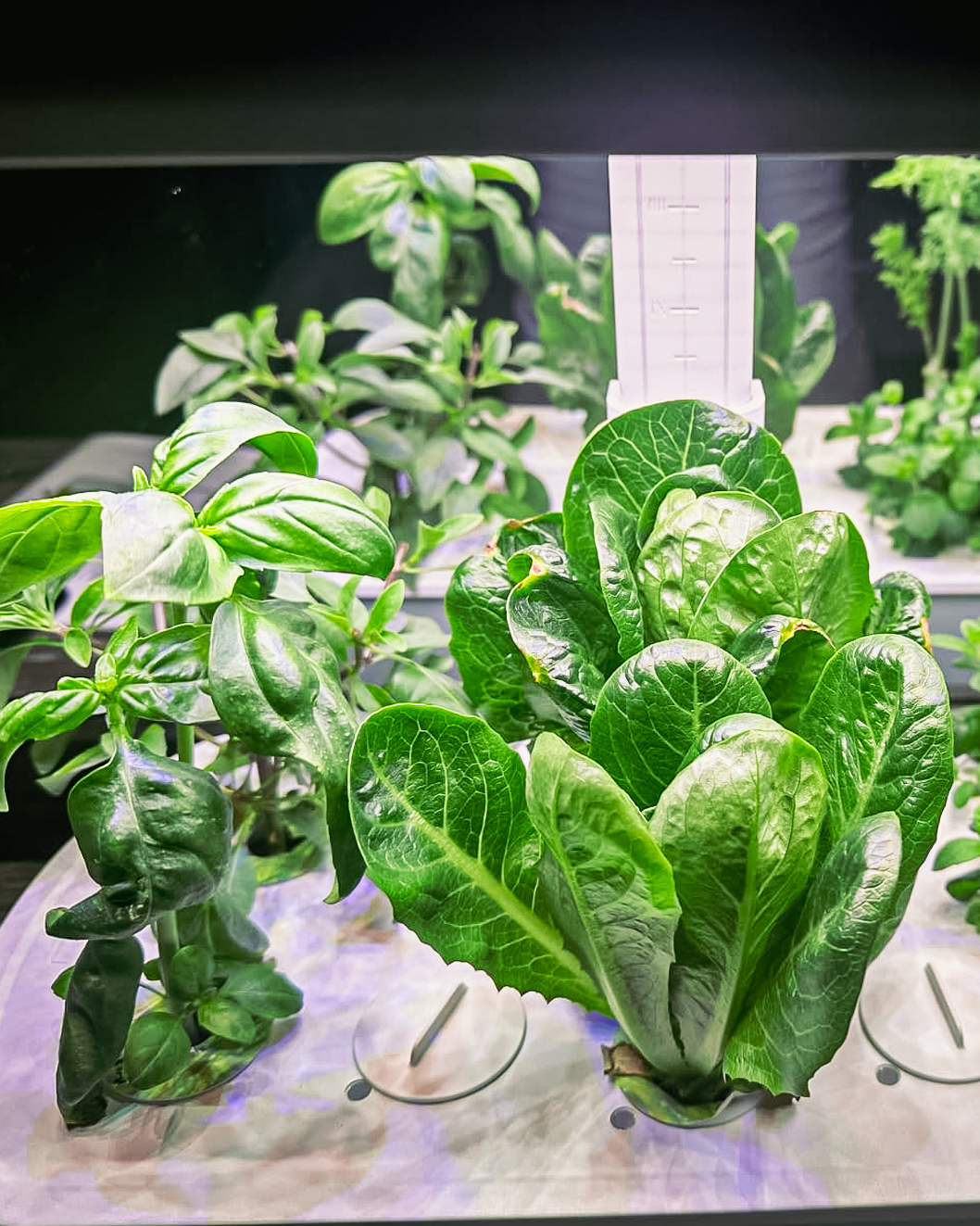
If you want a kitchen counter herb supply you barely think about: A DWC smart garden. The pump, light, timer and reservoir all come pre-built, and most models will run 12 to 14 days between top-ups. This is what I recommend for 80 percent of first-time hydroponic growers — and what almost every customer I have helped choose ends up keeping long-term.
If you want lettuce in volume — 20+ heads a week: NFT. The density is unmatched. Build it on a balcony rack or shelving unit and rotate transplants weekly.
If you want tomatoes, peppers or chillies indoors: Ebb and flow. The medium gives the root structure these fruiting crops need, and the flood cycles keep nutrients fresh.
If you want maximum speed or to clone cuttings: Aeroponics. Accept that it needs more attention and a backup power plan.
Hydroponics consistently outpaces soil for these crops. My own side-by-side trials, and a growing body of extension research, show 30 to 50 percent faster growth in soilless setups — see also do plants grow faster hydroponically or in soil.
My setup recommendations
Here are the exact pairings I recommend after years of testing. These are the rigs I personally run or have sent friends home with.
Total beginner, under 50 euros: A Kratky jar with mason jar, net cup, grow sponge and 100 ml of nutrients. Plant a sweet basil or salad bowl lettuce. Harvest in 4 to 5 weeks. No pump, no light if you have a south-facing window.
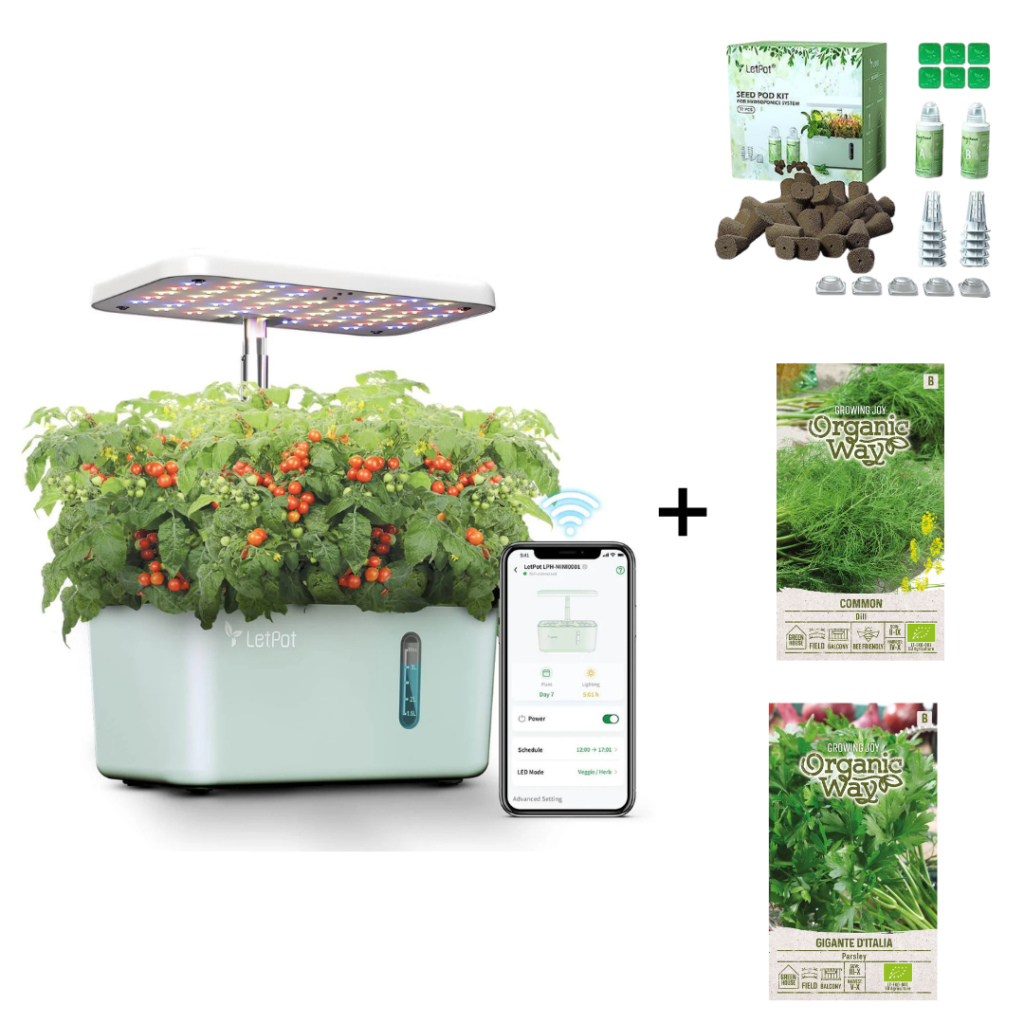
Easy kitchen DWC, under 150 euros: A small 5-pod plug-and-play smart garden with onboard LED and pump. The LetPot Mini herb starter bundle is the kit I recommend most — it ships with seeds, pods and nutrients, so there is nothing to forget. I have set this up for two relatives who had never grown anything; both still use it three years later.
Mid-size DWC, 12 pods: A LetPot Senior or LPH-Lite handles a full kitchen herb line plus a couple of lettuce heads. App control matters more than I expected — being able to check water level from my phone on a trip saved one of my basil runs last summer.
NFT for lettuce volume: A 4-channel PVC rig with 100 mm pipe, 10 W pump, 20 L reservoir, and a 60 W LED bar. About 120 euros total, and capable of 16 to 20 heads per cycle.
Ebb and flow for chillies or tomatoes: A 60 x 40 cm flood tray, 25 W submersible pump, mechanical timer with 15-minute increments, clay pebbles, and a 100 W LED. Around 180 euros. Plan for two flood cycles per day in seedling stage, four per day in fruit set.
Aerocloner build: A 20 L bucket with 8 LPA sprayers, 40 W pump, timer at 1-minute on / 5-minutes off. Around 90 euros. Strikes cuttings in 5 to 10 days for almost any soft-wood herb or vegetable.
Frequently asked questions
Which hydroponic system is easiest for beginners?
Kratky for a single jar, or a small DWC smart garden for a counter setup. Both are forgiving, cheap, and produce edible greens in 4 to 6 weeks. I started with Kratky on a windowsill and graduated to a smart garden once I wanted more herbs at once.
Which system grows plants fastest?
Aeroponics gives the highest growth rates in my tests — about 20 to 40 percent faster than DWC for basil, because roots get the most oxygen contact. NFT is a close second. DWC and ebb-and-flow are similar, then Kratky is the slowest.
Can I grow tomatoes in any of these systems?
Practically, ebb and flow is the most reliable choice for tomatoes because the medium supports the root mass. DWC works for cherry varieties if you use a 20 L+ reservoir. NFT and Kratky generally do not work — the plant outgrows the system.
How much electricity does a hydroponic system use?
A small DWC smart garden uses around 25 to 40 W total (light + pump), which is about 0.6 to 1.0 kWh per day. NFT and ebb and flow use slightly more if you add LED panels. Kratky uses zero electricity. Most home systems cost under 5 euros per month to run.
Do hydroponic plants need special nutrients?
Yes. Soil nutrients usually lack one or more elements that soil itself provides. Use a complete two-part or three-part hydroponic nutrient that includes nitrogen, phosphorus, potassium, plus calcium, magnesium and the micronutrients. Target EC depends on the crop (1.2 to 1.8 mS/cm for greens, 2.0 to 3.0 for fruiting).
How often do I change the nutrient solution?
Full reservoir change every 2 to 3 weeks is my rule for DWC, NFT and ebb and flow. Top up with fresh nutrient mix in between as the level drops. Aeroponics needs more frequent changes (every 7 to 10 days) because EC drifts faster in low-volume systems.
What pH range do hydroponic plants need?
5.8 to 6.2 for most vegetable and herb crops. Below 5.5 you lose calcium and magnesium uptake; above 6.5 iron becomes inaccessible. A 10 euro pH meter pays for itself in saved harvests within two months.
Can I run any of these in a small apartment?
Yes — all five fit in an apartment. Kratky uses windowsill space. A 5-pod smart garden takes 30 by 15 cm of counter. NFT, ebb and flow, and aeroponics need a corner or shelving unit but still work in a one-bed flat. I ran DWC and NFT side by side in a 45 m² Tallinn apartment for three years.
Where to start
If you want one piece of advice from this whole guide, it is this: do not overthink your first build. Pick the simplest method that fits your space and start. A Kratky jar costs less than a takeaway dinner and teaches you everything you need to know about how roots, water and nutrients interact. From there, you will know if you want to step up to a hands-off DWC smart garden, or build a more ambitious NFT or ebb-and-flow rig.
The five system types are not in competition — they are tools for different jobs. Pick the right tool, accept the trade-offs (electricity, complexity, maintenance), and you will be eating your own herbs and greens within a month. I have not bought supermarket basil in over four years.
Common mistakes across all five systems
After helping dozens of friends and customers build their first hydroponic setup, I see the same five mistakes again and again. Avoid these and your first crop will almost certainly succeed.
1. Skipping the EC and pH meters. A 10–20 euro pH pen and a 25–40 euro EC meter pay for themselves in the first month. Without them you are guessing, and guessing wrong is what kills hydroponic plants. I check pH every 3–4 days and EC weekly on every system I run.
2. Letting water temperature drift above 24 C. Warm water holds less oxygen and breeds pythium (root rot). On sunny windowsills, reservoir temperature can hit 28 C in a single afternoon. I wrap clear reservoirs in foil, move them away from direct sun, and on Senior-size DWC builds add a 15 euro aquarium chiller in July and August.
3. Overpacking the system. A 5-pod smart garden does not become a 10-pod one because you cram seeds tighter. Roots tangle, nutrients run out, light is blocked. Stick to the manufacturer pod count. For DIY, plan for 15–20 cm between mature leafy greens and 30–40 cm between fruiting plants.
4. Using soil fertilizer. A garden centre 7-7-7 will not work in hydroponics. It is missing calcium, magnesium and the trace elements your plant cannot pull from soil. Use a complete hydroponic nutrient (two-part or three-part). The cost difference is around 1 cent per litre of solution — trivial compared to a failed crop.
5. Ignoring light. Even DWC and Kratky need 12–16 hours of strong light per day for greens. A south-facing window in July is enough for basil; in January in northern Europe it is not. Plan for a 15–60 W LED if you live above the 50th parallel. My own basil yields tripled when I added a 24 W LED panel above a winter Kratky shelf.
How the five systems compare on water and nutrient use
One of the strongest arguments for hydroponics over soil is resource efficiency. My own measurements, broadly aligned with figures cited by USDA and university extensions, look like this:
Water use, per lettuce head, harvest cycle: Soil garden ~12 L. DWC ~2.5 L. NFT ~1.2 L. Ebb and flow ~2.0 L. Aeroponics ~0.4 L. Kratky ~1.0 L (no recirculation losses).
Nutrient use, per lettuce head: Soil ~5 g fertilizer per cycle. Hydroponic systems all consume around 1.5–2 g of dry-equivalent nutrient salts per head, because nothing leaches into the ground.
Footprint, per kg of harvest: Soil greens need about 0.6 m² per kg per cycle. Vertical NFT and aeroponic stacks can deliver the same kg of greens from 0.05–0.1 m² of floor space. That is a 6–12x footprint reduction — the reason vertical farming exists at all.
Numbers vary with crop, climate and skill, but the trend is consistent across every academic study I have read and every measurement I have made at home: hydroponics uses dramatically less water, less land, and similar or fewer nutrients than soil for leafy greens and small fruiting crops.
My honest verdict after five years
If I could only keep one system, it would be a 12-pod DWC smart garden. It hits the best balance of low maintenance, decent yield, multiple crops at once, and zero-fuss daily routine. I top it up on Sundays, change the reservoir every three weeks, and harvest a bowl of herbs and a head of lettuce most weeks of the year. Total electricity cost: around 4 euros a month. Total nutrient cost: around 2 euros a month. Total seeds and sponges: around 3 euros a month. Net: under 10 euros a month for fresh herbs that would cost 30–40 euros at the supermarket.
Kratky stays on my windowsill as a backup and a teaching tool. NFT and ebb and flow get unboxed when I am running a project (lettuce volume, chilli season). Aeroponics comes out when I want to clone a plant variety I love.
The most common question I get is “which one is best?” and the honest answer is: best for what. Best for beginners is DWC or Kratky. Best for density is NFT. Best for fruiting crops is ebb and flow. Best for speed is aeroponics. Pick the one that matches your goal and you will not regret it.